

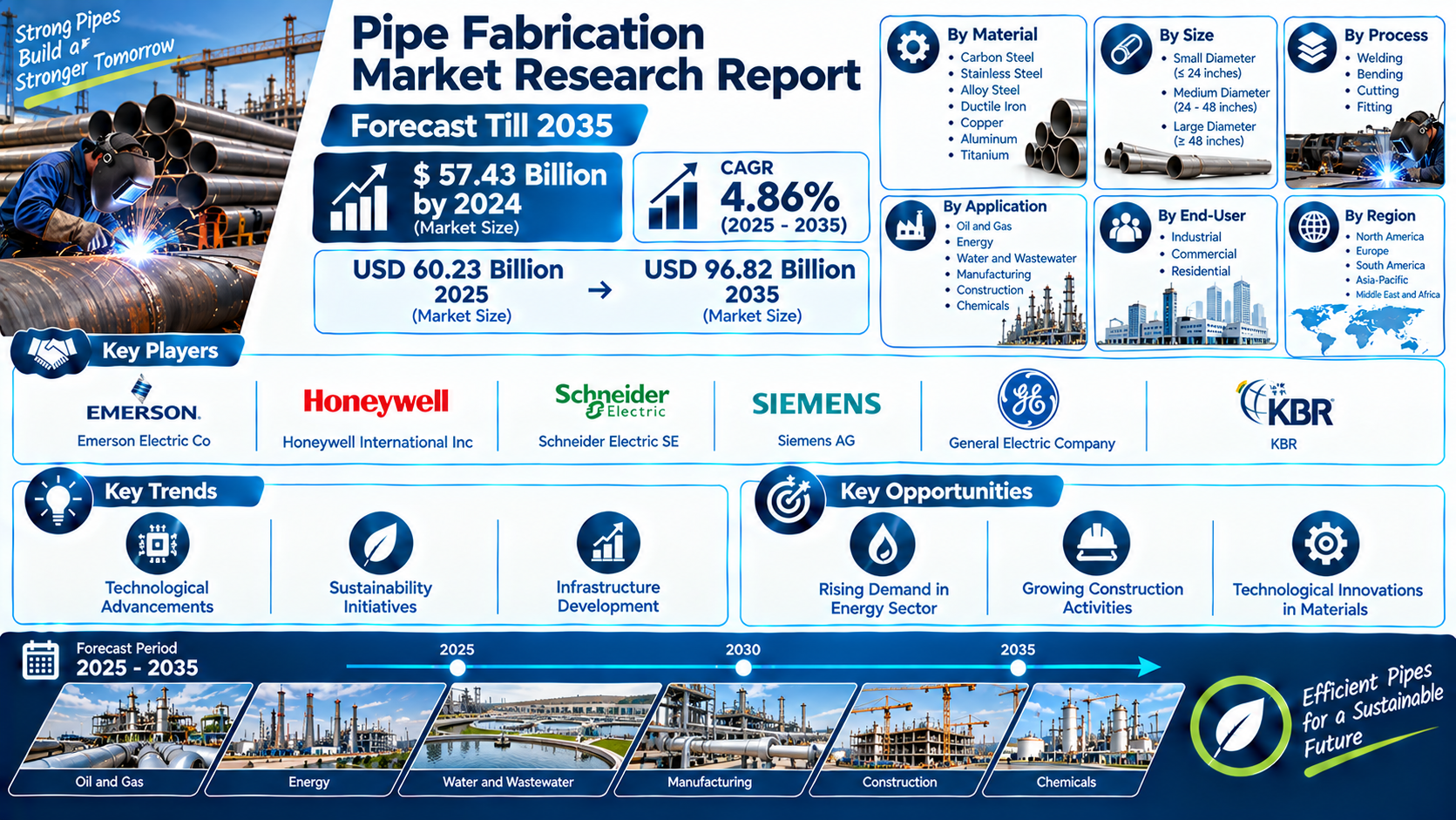

According to Market Research Future® (MRFR), the Pipe Fabrication Market is expected to reach USD 96.82 billion by 2035, up from USD 60.23 billion in 2025. The market is forecast to register a CAGR of 4.86% during 2025–2035, following a valuation of USD 57.43 billion in 2024. Its expansion is associated with the need for fabricated piping systems in energy, oil and gas, water and wastewater, manufacturing, construction and chemical operations.
The Role of Pipe Fabrication Across Industries
Pipe fabrication converts pipe materials into components and assemblies that can be installed in specific systems. The process involves several activities, including cutting, bending, welding and fitting. These operations prepare pipes to meet design dimensions and functional requirements, allowing them to be incorporated into facilities and infrastructure. Fabricated piping is used in environments ranging from residential and commercial buildings to large industrial installations.
The market serves a diverse customer base because piping systems perform different functions across industries. Energy facilities, manufacturing plants and chemical operations may require products designed for demanding service conditions. Water and wastewater networks have their own requirements related to system design and long-term operation. Construction projects also depend on fabricated pipes for building and infrastructure installations. This variety supports demand for different materials, sizes and production processes.
The forecast indicates that the market will maintain a growth trajectory over the coming decade. From USD 60.23 billion in 2025, its value is projected to rise to USD 96.82 billion in 2035. The CAGR of 4.86% represents the expected annualized growth rate over the forecast period. The market's 2024 value of USD 57.43 billion provides a baseline for the subsequent expansion.
Material Diversity and Diameter Segmentation
Material selection is a central consideration in fabrication because the pipe must be suitable for its intended operating environment. The market includes carbon steel, stainless steel, alloy steel, ductile iron, copper, aluminum and titanium. Carbon steel and alloy steel serve a range of industrial requirements, while stainless steel is relevant where corrosion resistance is a priority. Ductile iron provides another option for applications requiring strength and durability.
Copper and aluminum are used where their respective material characteristics meet project needs. Titanium is included as a category for specialized requirements. The choice among these materials depends on factors such as the application, operating conditions, fluid or process environment, mechanical requirements and project specifications. Fabricators must also consider how material characteristics affect cutting, bending, welding and fitting operations.
Pipe size provides a further basis for segmentation. The report identifies small diameter, medium diameter and large diameter pipes. Its supplied descriptions are Small Diameter (24 inches), Medium Diameter (24–48 inches) and Large Diameter (48 inches). The small and large diameter descriptions do not specify inequality signs, so their precise boundary definitions should be checked against the original classification. Diameter remains an important fabrication consideration because it affects equipment selection, handling, joining procedures and installation requirements.
Processes That Shape Fabrication Capabilities
Welding is used to join pipe sections and create assemblies according to engineering requirements. The process requires suitable procedures and quality controls to ensure that connections meet the intended specifications. Bending changes the direction or configuration of a pipe, allowing it to fit the layout of a system. Cutting prepares pipe sections to required lengths and dimensions, while fitting involves assembling components and connections into the required configuration.
The four processes are closely connected in many fabrication projects. Their application depends on the design, material, pipe dimensions and conditions under which the finished system will operate. A fabricator's ability to coordinate these activities can affect production accuracy, project schedules and the consistency of completed assemblies. The appropriate methods also vary according to the technical requirements of the end-use industry.
Application and End-User Demand
Oil and gas, energy, water and wastewater, manufacturing, construction and chemicals are the application segments identified in the report. Oil and gas operations use piping systems in industrial facilities and related infrastructure. Energy applications require fabricated components suited to the needs of power and other energy-related installations. Water and wastewater systems depend on piping networks for the movement and management of water.
Manufacturing facilities use pipes as part of production and processing systems. Construction creates demand through building projects and infrastructure installations, while chemical operations require piping materials and fabrication methods suited to specific process conditions. These application categories demonstrate the range of environments in which fabricated piping products are used.
The end-user segmentation comprises industrial, commercial and residential customers. Industrial demand is linked to production facilities, energy installations and other large-scale operations. Commercial users require piping systems for buildings and business facilities, while residential applications are associated with housing and related installations. Each category has distinct project scales and specifications, influencing the materials and fabrication services required.
Regional Market Development
The market is divided geographically into North America, Europe, South America, Asia-Pacific, and the Middle East and Africa. Regional demand reflects differences in infrastructure investment, industrial development, energy requirements and construction activity. Markets with significant industrial operations may require specialized fabrication services, while infrastructure and water management projects can support demand for piping systems in other regions.
Regional market conditions also influence procurement and project delivery. Customers may prioritize different material grades, dimensions and fabrication processes depending on local standards and the nature of their projects. Suppliers serving multiple regions must be able to address these differences while maintaining product quality and meeting applicable technical requirements.
Technology and Sustainability as Market Trends
Technological advancements are changing the way fabrication operations can be managed. Improvements in machinery, process control and inspection methods can support dimensional accuracy and consistent production. Greater precision is particularly relevant for projects involving complex piping layouts or specific engineering requirements. Technology adoption can also help fabricators coordinate production activities and respond to varied customer specifications.
Sustainability initiatives are becoming increasingly relevant to the wider industrial sector. Pipe fabrication businesses must consider how they use raw materials, energy and production resources. Material planning and efficient cutting practices can help limit avoidable waste, while improved process management can support resource efficiency. These considerations may influence operational decisions as customers and project stakeholders place greater emphasis on environmental performance.
Infrastructure development is another important trend. Investment in water and wastewater networks, energy systems, industrial facilities and construction projects creates requirements for piping products and associated fabrication services. The scale and timing of these projects influence the demand outlook across regions and applications.
Key Participants and Growth Opportunities
Emerson Electric Co, Honeywell International Inc, Schneider Electric SE, Siemens AG, General Electric Company and KBR are among the key players identified in the market. These companies have activities across broader industrial technology, automation, engineering and project-related sectors. Their roles in the market may differ, and the list should not be interpreted as indicating that every organization is exclusively a pipe fabrication manufacturer. Their relevance reflects the wider ecosystem in which industrial piping systems are designed, supplied and deployed.
The energy sector offers an opportunity as facilities and related infrastructure require piping systems suited to defined operating conditions. Growing construction activities can also support demand for fabricated pipes in building and infrastructure projects. In addition, technological innovations in materials may provide opportunities to address applications with particular performance requirements.
Material innovation can influence both product selection and fabrication practices. As customers evaluate options for different operating environments, the availability of suitable materials and the ability to process them effectively become important. Companies that understand material properties and fabrication requirements can respond to a wider range of project specifications.
Market Outlook to 2035
The pipe fabrication market's forecast reflects demand from multiple industries rather than reliance on one application. Energy, oil and gas, manufacturing, construction, water and wastewater, and chemical operations all contribute to the need for fabricated piping systems. Material diversity and the availability of welding, bending, cutting and fitting capabilities help the industry address different project requirements.
The projected increase to USD 96.82 billion by 2035, from USD 60.23 billion in 2025, represents a CAGR of 4.86%. Infrastructure development, technological advancements and sustainability initiatives will remain relevant to the market's direction. Long-term competitiveness will depend on delivering reliable fabrication services, meeting technical specifications and adapting to changing industrial and construction requirements.

