

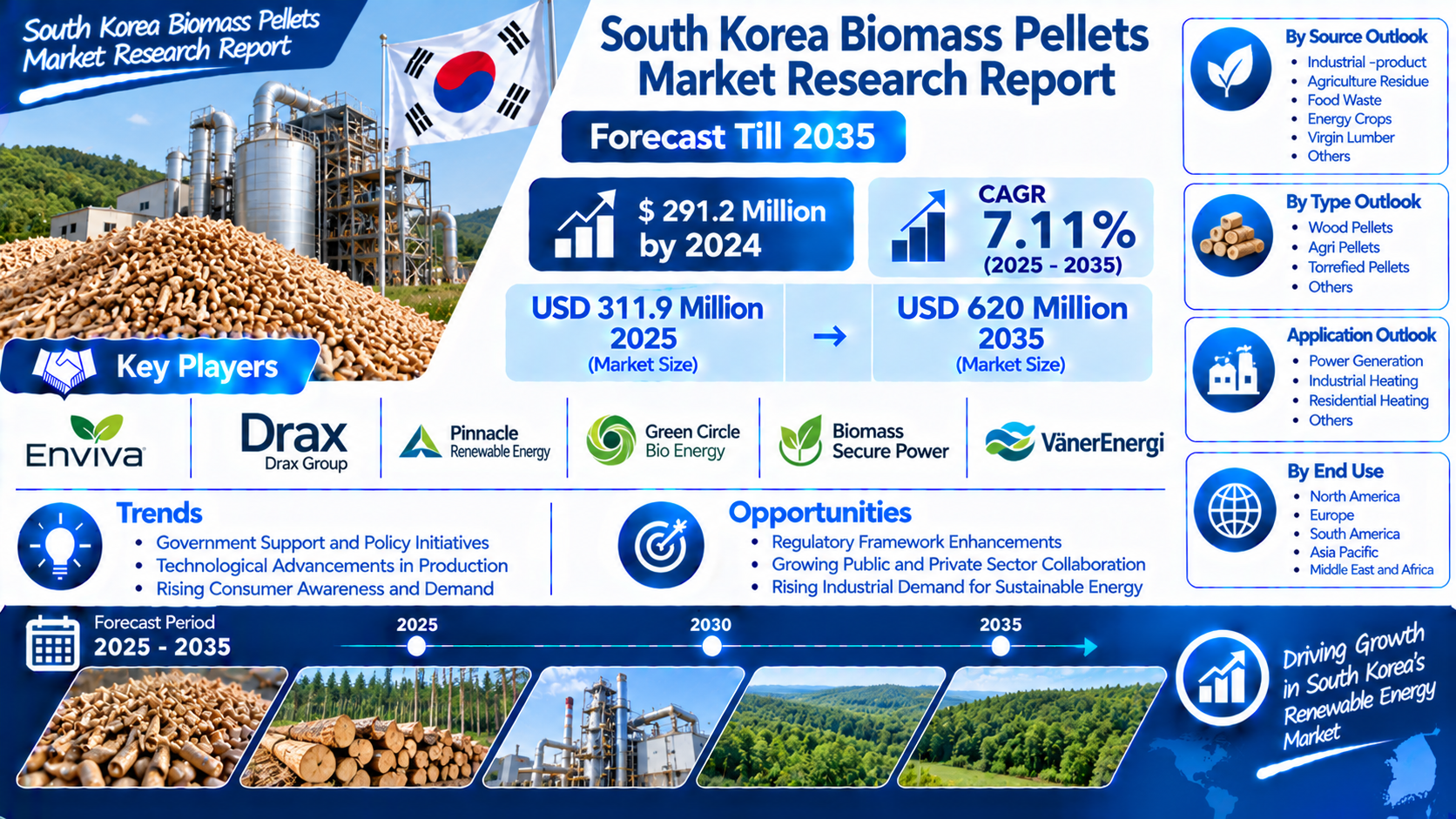
South Korea Biomass Pellets Market to Reach USD 620 Million by 2035 at 7.11% CAGR

According to Market Research Future® (MRFR), the South Korea Biomass Pellets Market is projected to grow from USD 311.9 million in 2025 to USD 620 million by 2035, registering a compound annual growth rate (CAGR) of 7.11% during the forecast period from 2025 to 2035. The market was valued at USD 291.2 million in 2024. Government support, policy initiatives, technological advancements in production and rising consumer awareness are among the factors shaping the industry's development. Demand for sustainable energy across power generation, industrial heating and residential heating also provides opportunities for market participants.
Sustainable Energy Demand Supports Market Development
Biomass pellets are a solid biofuel produced from organic materials and used in different energy applications. Their role in power generation and heating connects the market with efforts to diversify energy sources and incorporate renewable alternatives into energy systems. In South Korea, the market's development is influenced by policy direction, industrial energy requirements and interest in sustainable energy solutions.
Power generation is one of the principal application categories identified in the report. Biomass pellets can serve as a fuel input in facilities designed or equipped to use them. Industrial heating represents another application, with demand linked to the energy needs of manufacturing and other industrial operations. Residential heating provides an additional market channel, reflecting the potential use of pellet-based fuels in household energy systems.
The report also includes other applications, indicating that the market extends beyond these three principal categories. The relative importance of each application depends on fuel suitability, infrastructure, operating requirements and the economics of energy supply.
Biomass Sources and Feedstock Outlook
The market's source segmentation includes industrial by-products, agricultural residue, food waste, energy crops, virgin lumber and other sources. This range reflects the different feedstock categories that can contribute to biomass pellet production.
Agricultural residue provides a potential source of raw material by making use of biomass generated through agricultural activities. Food waste represents another category, connecting pellet production with the management and utilization of organic waste streams where suitable processing systems are available. Industrial by-products can also provide feedstock opportunities, depending on their composition and suitability for conversion.
Energy crops and virgin lumber are additional source categories. Their availability and use can depend on sourcing practices, land-use considerations and the requirements of pellet manufacturers. The diversity of sources gives producers several potential feedstock options, although consistent quality, collection systems and processing costs remain important considerations.
Pellet Types and Production Technology
By type, the market is segmented into wood pellets, agricultural pellets, torrefied pellets and other pellets. Wood pellets represent a recognized category of biomass fuel, while agricultural pellets use suitable agricultural materials as feedstock. Torrefied pellets provide another product category, distinguished by the thermal treatment applied during production.
Technological advancements in production are identified as a key market trend. Improvements in processing and pellet manufacturing can help producers address product consistency, fuel characteristics and operational efficiency. The ability to process different feedstock types while maintaining reliable product quality is important to serving power generation and heating customers.
Production technology also influences the commercial suitability of biomass pellets. Buyers may consider factors such as fuel quality, handling requirements and compatibility with existing equipment when evaluating suppliers. Continued technical development can therefore support the market's ability to serve a broader range of applications.
Government Support and Policy Initiatives
Government support and policy initiatives are important trends shaping the South Korea biomass pellets market. Regulatory direction can influence the adoption of renewable energy sources, investment decisions and the operating environment for energy producers. A supportive framework can encourage businesses to evaluate biomass as part of their energy strategies.
The report identifies regulatory framework enhancements as an opportunity. Clearer or more developed regulations may help establish conditions for market participation, investment and the integration of sustainable energy sources. The effect of policy changes will depend on the specific measures introduced and how they influence producers, energy users and supply chains.
Growing public and private sector collaboration is another opportunity. Cooperation between government bodies, energy companies, biomass producers and other stakeholders may help address issues involving feedstock availability, production capacity, logistics and end-use infrastructure.
Industrial Demand and Consumer Awareness
Rising industrial demand for sustainable energy is identified as a key opportunity. Industrial facilities require dependable energy inputs, and interest in alternative fuels may encourage the evaluation of biomass pellets for suitable heating and energy applications. Adoption depends on fuel economics, equipment compatibility, supply reliability and operational requirements.
Rising consumer awareness and demand are also among the market trends. Greater awareness of sustainable energy options can influence household and business interest in alternative heating fuels. Residential heating provides a potential route for this interest to translate into demand, although adoption will depend on access to suitable equipment and reliable pellet distribution.
Competitive Landscape and Market Outlook
The key companies identified in the report include Enviva, Drax Group, Pinnacle Renewable Energy, Green Circle Bio Energy, Biomass Secure Power and VänerEnergi. These companies form part of the competitive landscape presented for the market. Their inclusion does not imply that every company has the same operating presence or market role in South Korea.
Competition may involve feedstock sourcing, production capabilities, product quality, supply reliability and relationships with energy users. Suppliers that can provide consistent pellets and respond to changing customer requirements may be better positioned to participate in market opportunities.
The South Korea biomass pellets market is forecast to increase from USD 311.9 million in 2025 to USD 620 million by 2035, at a CAGR of 7.11%. The 2024 market valuation of USD 291.2 million provides the preceding reference point. Government initiatives, technological advancements, regulatory development and collaboration between public and private stakeholders are expected to remain important factors. With applications spanning power generation and heating, the market's future development will depend on the availability of suitable feedstocks, dependable production and growing demand for sustainable energy.

