

Europe Hot Dip Galvanizing Market: Infrastructure Development and Automotive Demand

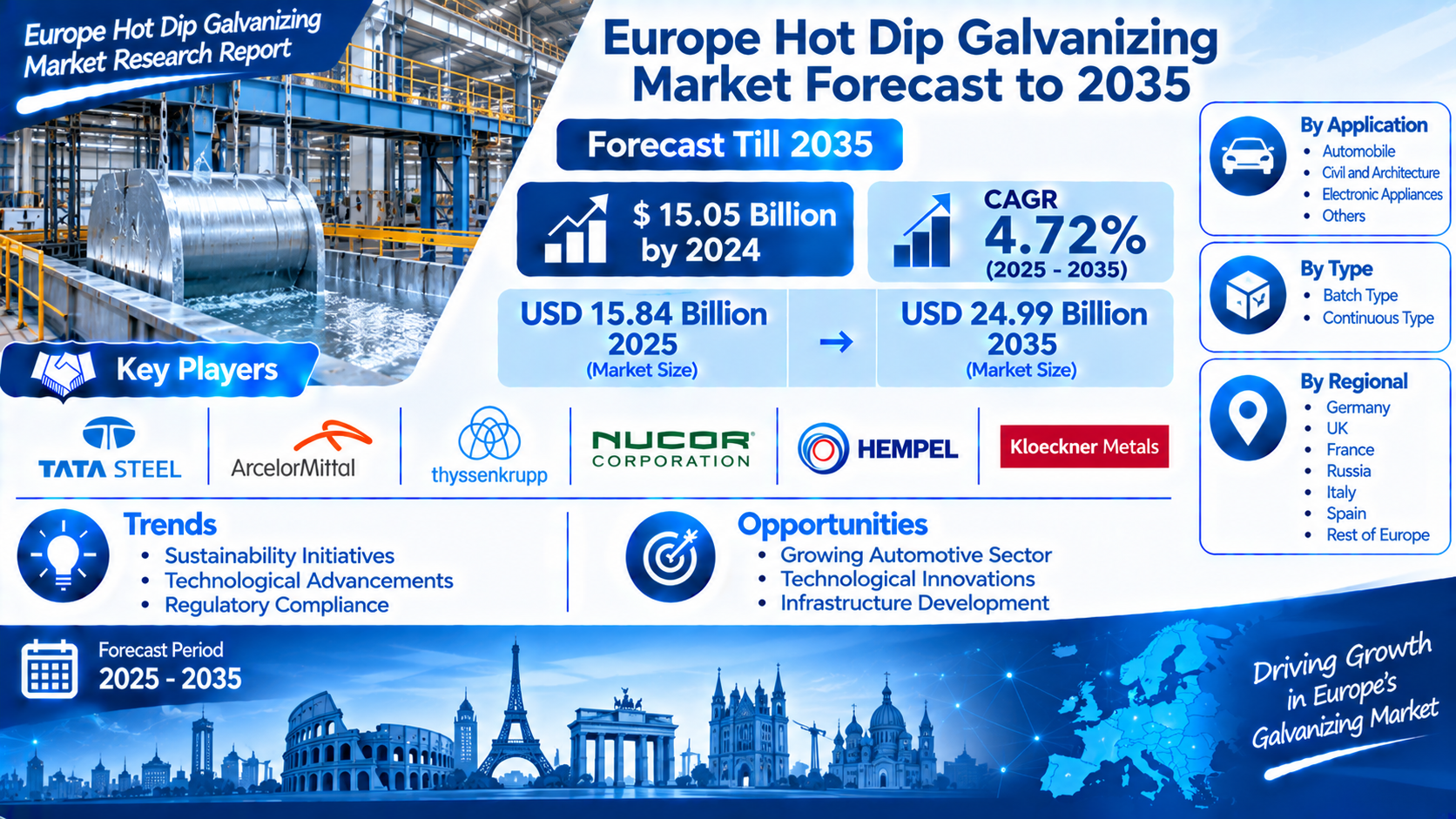
According to Market Research Future® (MRFR), the Europe Hot Dip Galvanizing Market is expected to reach USD 24.99 billion by 2035, compared with USD 15.84 billion in 2025. The market is forecast to expand at a CAGR of 4.72% between 2025 and 2035, following a valuation of USD 15.05 billion in 2024. Hot dip galvanizing protects steel and iron products by applying a zinc coating, helping improve their resistance to corrosion. The process serves a broad range of applications in Europe, including automobiles, civil and architectural projects, electronic appliances, and other uses. Demand is shaped by the requirements of industries that depend on durable metal products and reliable surface protection.
Market Development Across Europe
Corrosion protection is a significant consideration in the use of steel products, particularly when components are exposed to outdoor conditions or demanding operating environments. Hot dip galvanizing provides a protective zinc layer that can help extend the useful life of steel products. This characteristic makes the process relevant to construction materials, infrastructure components, automotive applications, and selected products used in appliance manufacturing.
The market's reported valuation of USD 15.05 billion in 2024 provides the starting point for its recent performance. It increased to USD 15.84 billion in 2025 and is projected to reach USD 24.99 billion in 2035. A CAGR of 4.72% over the 2025–2035 period reflects the expected pace of market expansion. The outlook is connected to demand from multiple industries rather than a single end-use category, giving the market exposure to different sources of industrial and infrastructure activity.
Applications Driving Demand
Automobile applications are an important part of the market's demand structure. Steel components used in vehicles may require protective coatings to help manage corrosion and support durability. Hot dip galvanizing can serve relevant automotive material requirements, although the precise coating choice depends on the component, manufacturing process, and technical specifications established by producers.
Civil and architecture is another major application category. Steel is used in buildings and infrastructure, where exposure to moisture and environmental conditions can make corrosion resistance an important consideration. Galvanized steel components can be used in applications where protective performance and reduced maintenance requirements are valued. Construction activity and infrastructure development can therefore influence demand for galvanizing services and products.
Electronic appliances also contribute to the market's application base. Certain appliance components use metal materials that may benefit from protective coatings. The requirements differ according to product design, operating conditions, and manufacturing specifications. Other applications complete the segmentation, representing additional uses outside the automobile, civil and architecture, and electronic appliances categories.
Production Types: Batch and Continuous
The report divides the market by type into batch type and continuous type galvanizing. Batch galvanizing is used for individual steel products or groups of fabricated items. It can accommodate components with different shapes and dimensions, making it relevant to varied fabrication and construction requirements. The process is generally selected according to the physical characteristics of the items and the coating specifications required.
Continuous galvanizing is designed for steel products that can be processed through an ongoing production line. It is commonly associated with sheet and strip products supplied to downstream manufacturing applications. Continuous processing can support larger production volumes and consistent treatment across the material. Its suitability depends on the product format and the requirements of customers using the galvanized steel.
The two approaches serve different manufacturing needs. Batch operations can provide flexibility for varied products, while continuous lines are suited to production environments involving standardized steel formats and higher throughput. Quality management, coating consistency, and process efficiency remain important considerations for both.
Sustainability, Technology and Compliance
Sustainability initiatives are influencing how companies evaluate their manufacturing operations. Galvanizing businesses may focus on improving resource efficiency, managing production waste, and strengthening environmental practices. Customers also consider product durability when evaluating materials for construction and industrial applications. These factors can encourage attention to the lifecycle performance of steel products and the processes used to protect them.
Technological advancements are creating opportunities to improve galvanizing operations. Automation, process monitoring, and improved inspection methods can help manufacturers maintain consistent coating quality and manage production more effectively. Technology can also support better control over operational parameters and the handling of different product requirements. Investment decisions will depend on the expected benefits, cost, and compatibility with existing facilities.
Regulatory compliance remains a central operational requirement. Companies must meet relevant rules and standards governing industrial production, workplace safety, environmental management, and product quality. Requirements may vary between countries and can change over time. Businesses that maintain effective compliance systems can better manage operational obligations and respond to customer expectations.
Opportunities in Automotive and Infrastructure
Growth in the automotive sector presents opportunities for suppliers serving manufacturers that use corrosion-protected steel components. Changes in vehicle production, component specifications, and material requirements can influence the demand for galvanizing. Suppliers may benefit from maintaining the technical capabilities and quality systems required by automotive customers.
Technological innovations can support further development by improving coating processes, production efficiency, and inspection capabilities. Infrastructure development is another opportunity area. Civil engineering and construction projects can require steel products designed to withstand long-term exposure to environmental conditions. Galvanized steel may be considered where corrosion protection is a relevant performance requirement. The actual level of demand will depend on project pipelines, procurement decisions, and material specifications.
The key players identified for the market are Tata Steel, ArcelorMittal, Thyssenkrupp, Nucor Corporation, Hempel, and Kloeckner Metals. These organizations have different positions across the wider metals, steel, and coatings industries. Their inclusion in the market overview should not be taken to mean that all have identical galvanizing operations or the same geographic reach in Europe. Competition may involve steel supply, coating capabilities, technical support, distribution, and customer service.
Regional Coverage and Long-Term Outlook
The report identifies Germany, the UK, France, Russia, Italy, Spain, and Rest of Europe as regional segments. Their market conditions may reflect differences in automotive manufacturing, construction activity, infrastructure investment, and industrial demand. The regional structure provides a basis for assessing the geographic distribution of the European market without assuming that all countries experience the same growth conditions.
The market is projected to expand from USD 15.84 billion in 2025 to USD 24.99 billion in 2035, with a CAGR of 4.72%. Demand from automobile, civil and architecture, and electronic appliance applications will contribute to the market's outlook, while batch and continuous processes will serve different production requirements. Sustainability initiatives, technological advancements, regulatory compliance, and infrastructure development are expected to remain relevant to the industry's evolution through 2035.

