

Aerospace Composites Market Opportunities in Advanced Air Mobility and Material Recycling

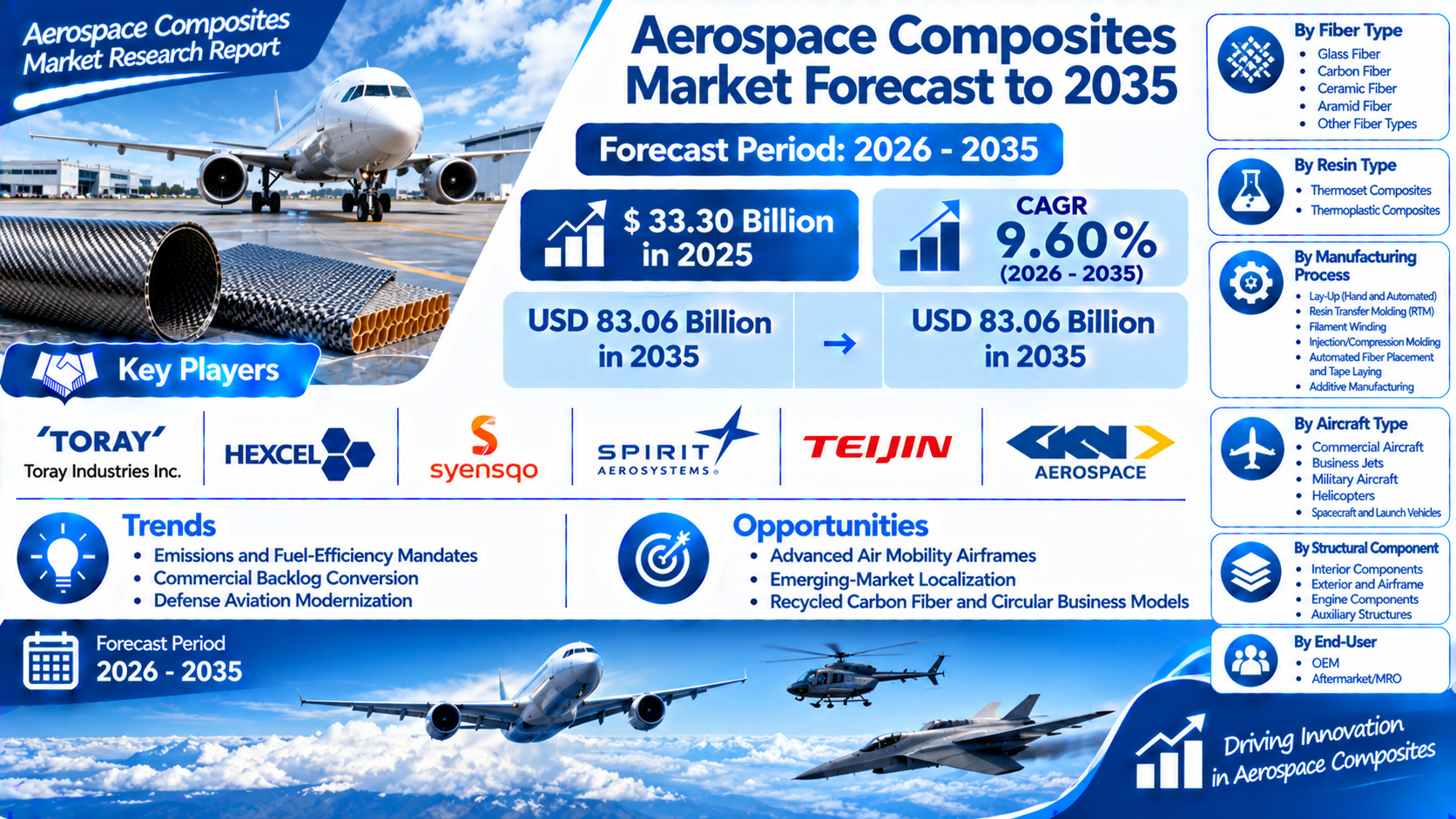
According to Market Research Future® (MRFR), the Aerospace Composites Market is expected to increase from USD 33.30 billion in 2025 to USD 83.06 billion by 2035, reflecting a CAGR of 9.60% over the 2026–2035 forecast period. This outlook places advanced composite materials within a significant phase of projected expansion as aerospace manufacturers address aircraft performance, fuel-efficiency objectives, production requirements, and modernization needs. The market spans a broad range of materials, manufacturing processes, aircraft categories, structural components, and end users.
Composites are relevant to aerospace engineering because they allow manufacturers to design materials and structures around specific performance requirements. Their potential to reduce weight while maintaining appropriate structural properties makes them valuable in an industry where material selection influences aircraft efficiency and design. However, aerospace adoption involves more than material performance alone. Manufacturers must also consider qualification, production repeatability, inspection, repair, and long-term operational requirements.
Market Valuation and Growth Drivers
The projected increase to USD 83.06 billion by 2035 highlights the expanding role of composites in aerospace applications. The stated CAGR of 9.60% for 2026–2035 is consistent, to rounding, with the movement from the 2025 market size of USD 33.30 billion to the 2035 projection. This growth outlook is linked to emissions and fuel-efficiency mandates, commercial backlog conversion, and defense aviation modernization.
Aircraft operators and manufacturers face continuing pressure to improve operating efficiency. Material weight is one of the considerations in aircraft design, and composites provide options for reducing structural mass while meeting component-specific engineering requirements. Their design flexibility also allows manufacturers to consider different fiber and resin combinations for distinct applications. These advantages must be balanced against material costs, manufacturing complexity, certification requirements, and the need for dependable supply.
Commercial backlog conversion is another important market trend. As aircraft manufacturers progress with existing production commitments, demand for materials and components used in aircraft construction may rise. Composite suppliers and aerospace component manufacturers therefore have an opportunity to support production programs through qualified materials and reliable manufacturing capacity. The pace of this opportunity will depend on production schedules and the ability of supply chains to meet customer requirements.
Defense aviation modernization adds a further dimension. Military aircraft programs cover fighter jets, transport and tanker aircraft, and rotorcraft, each with particular structural and operating demands. Composite materials can serve applications where weight, strength, and component design are important, although material choices remain subject to platform-specific requirements and qualification processes.
Fiber and Resin Choices
Fiber type is a major basis for market segmentation. The categories include glass fiber, carbon fiber, ceramic fiber, aramid fiber, and other fiber types. These materials are not interchangeable in every application. Their selection depends on the required mechanical properties, component function, operating environment, and manufacturing method. Carbon fiber is associated with high-performance lightweight structures, while other fiber types provide alternatives for applications with different design priorities.
The resin segment includes thermoset composites and thermoplastic composites. Resin systems influence processing, component characteristics, and manufacturing considerations. Thermoset composites have an established place in aerospace manufacturing, while thermoplastic composites offer a different combination of processing and material properties. Aerospace companies assess these systems in relation to structural requirements, production efficiency, qualification, and the intended service environment.
The range of fiber and resin combinations gives manufacturers flexibility in developing components for different aircraft platforms. It also creates a need for specialized technical expertise. Material suppliers must support customers with consistent product quality and technical data, while manufacturers must ensure that selected composite systems meet the applicable aerospace requirements.
Manufacturing Processes and Production Capabilities
The market includes several manufacturing processes: lay-up, including hand and automated methods; resin transfer molding (RTM); filament winding; injection/compression molding; automated fiber placement and tape laying; and additive manufacturing of composites. The presence of multiple processes reflects the diversity of aerospace components and production needs.
Lay-up methods provide approaches for building composite structures, with automation supporting greater process consistency in suitable applications. Automated fiber placement and tape laying are relevant to the production of composite structures where controlled fiber positioning is important. RTM, filament winding, and molding methods provide alternatives for components with different geometries and manufacturing requirements. Additive manufacturing of composites represents another process category within the market.
The appropriate process depends on component design, material selection, production volume, dimensional tolerances, and quality requirements. Aerospace manufacturing also requires rigorous process control because defects or variations can affect component performance. As a result, the development of production capability involves investment in equipment, technical skills, inspection procedures, and qualification.
Aircraft Types and Structural Components
The aircraft-type segmentation covers commercial aircraft, business jets, military aircraft, helicopters, and spacecraft and launch vehicles. Commercial aircraft are further divided into narrow-body aircraft, wide-body aircraft, regional jets, and freighters. Military aircraft include fighter jets, transport and tanker aircraft, and rotorcraft. This segmentation shows that demand is distributed across platforms with different operating profiles and design priorities.
Structural component categories include interior components, exterior and airframe structures, engine components, and auxiliary structures. Composite applications across these areas depend on the performance requirements of each part. Airframe and exterior structures are relevant to weight-management objectives, while interior and auxiliary components provide additional application areas. Engine components have their own demanding operating conditions and material requirements.
The breadth of aircraft categories and structural applications supports demand for a range of composite materials and manufacturing capabilities. Nevertheless, the extent of adoption varies according to aircraft design, certification requirements, production programs, and the suitability of composites for each component.
OEM and Aftermarket Demand
The market's end-user categories are original equipment manufacturers (OEMs) and the aftermarket/maintenance, repair, and overhaul (MRO) sector. OEMs use composite materials in the manufacture of new aircraft and components. Their requirements include material qualification, production consistency, engineering support, and the ability to meet delivery schedules.
The aftermarket and MRO segment has a different focus. Composite structures require inspection and repair approaches suited to their material characteristics. Maintenance providers must understand the condition of composite components and apply appropriate procedures to support continued aircraft operation. As the installed base of composite-containing aircraft develops, aftermarket requirements may provide an additional area of demand.
Trends and Opportunity Areas
Emissions and fuel-efficiency mandates are encouraging continued attention to lightweight aerospace materials. Commercial backlog conversion may support demand as production programs advance, while defense aviation modernization creates opportunities across military aircraft applications. Together, these trends connect composite demand with both commercial production and government-supported aviation requirements.
Three opportunity areas are identified: advanced air mobility airframes, emerging-market localization, and recycled carbon fiber and circular business models. Advanced air mobility represents a developing field in which lightweight structures may be important to aircraft design. Its commercial potential will depend on certification, infrastructure, production readiness, and adoption. Emerging-market localization could create opportunities for regional manufacturing and supply-chain development. Recycled carbon fiber and circular business models may help address material recovery, waste reduction, and resource efficiency.
Competitive Outlook Through 2035
The key players identified in the Aerospace Composites Market are Toray Industries Inc., Hexcel Corporation, Syensqo, Spirit AeroSystems, Teijin Limited, and GKN Aerospace. Competition in this sector involves material development, manufacturing expertise, quality assurance, customer relationships, and the ability to meet aerospace qualification standards. Suppliers and component manufacturers must demonstrate that their products can satisfy the technical and operational requirements of aircraft programs.
With a projected market value of USD 83.06 billion in 2035 and a CAGR of 9.60% during 2026–2035, the Aerospace Composites Market is expected to expand across multiple material and application categories. Commercial aircraft production, defense modernization, efficiency objectives, and emerging air mobility applications are likely to remain important areas of attention. The industry's progress will ultimately depend on the successful combination of material performance, scalable manufacturing, certification, and dependable support throughout the aircraft lifecycle.

