

Cut Stack Label Market Expansion Driven by Technological Innovations in Labeling

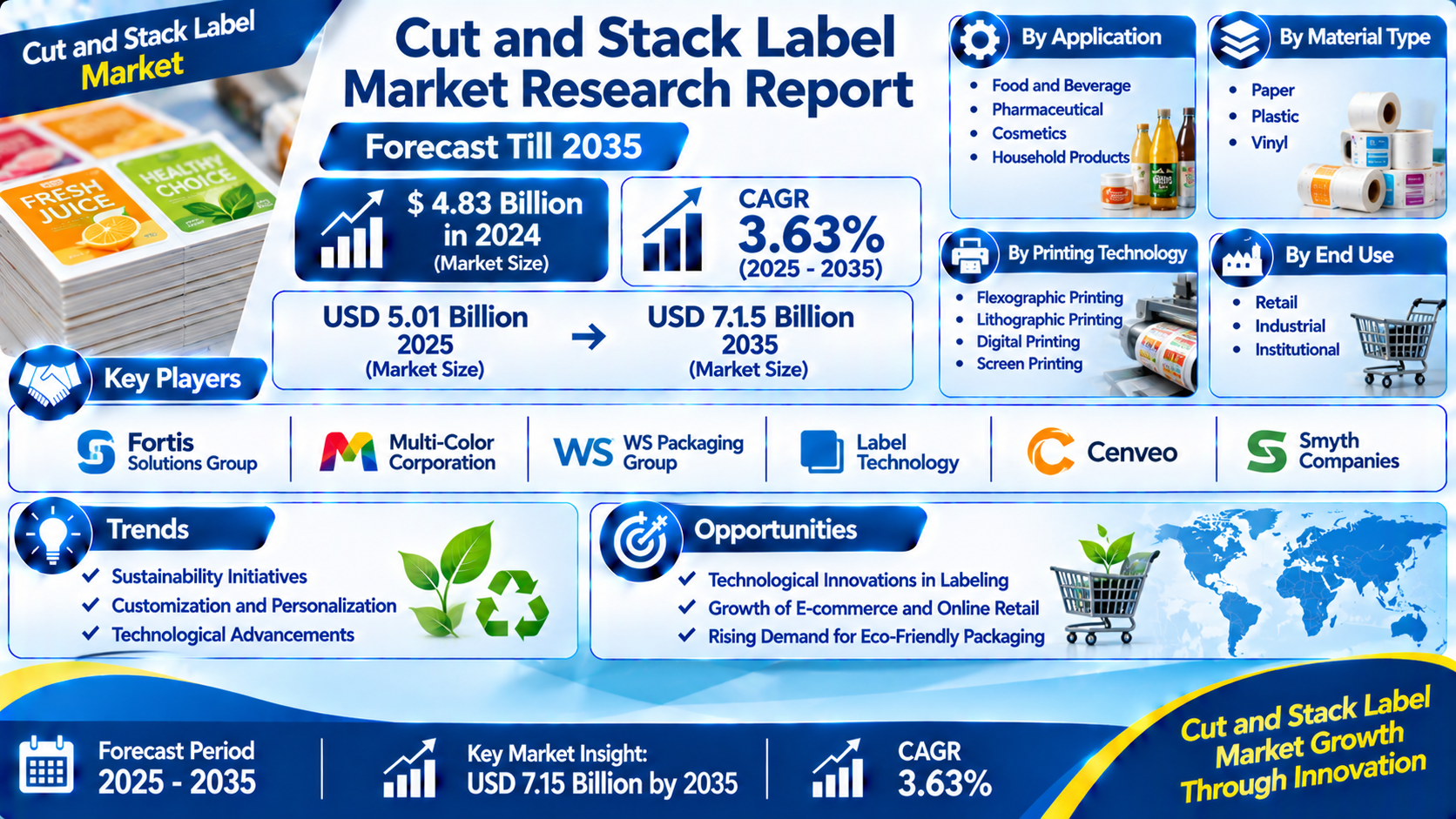
According to Market Research Future® (MRFR), the Cut Stack Label Market is expected to expand at a CAGR of 3.63% between 2025 and 2035, with market value rising from USD 5.01 billion in 2025 to USD 7.15 billion by 2035. The market recorded a valuation of USD 4.83 billion in 2024. Its outlook reflects the continued use of labels across packaged consumer goods and other applications, together with changing expectations around packaging sustainability, personalized designs, and printing technology.
Market Landscape and Product Applications
Cut stack labels serve product packaging and identification needs across several industries. Their applications include food and beverage products, pharmaceuticals, cosmetics, and household products. These categories rely on labels to communicate product identity and support packaging presentation. The requirements can differ by product type, packaging format, and the information or design elements that need to be displayed.
Food and beverage packaging represents one application area, while pharmaceutical products require labeling suited to their product identification and information needs. Cosmetics companies use labels as part of packaging design and brand presentation. Household products also rely on labels to distinguish packaged goods and communicate relevant product details.
This diversity gives label manufacturers access to customers across multiple product categories. It also means that suppliers must accommodate different design specifications, materials, and printing requirements. The market's segmentation reflects this variety, covering several material types, printing technologies, and end-use categories.
Market Performance and Long-Term Forecast
The market was valued at USD 4.83 billion in 2024 and is estimated to reach USD 5.01 billion in 2025. By 2035, its value is projected to increase to USD 7.15 billion. The expected CAGR is 3.63% over the 2025–2035 forecast period.
The forecast indicates a steady growth path over the coming decade. Demand is connected with the continued use of packaged products and the need for labels that meet functional and visual requirements. Market participants can serve customers through different materials and printing processes, with product specifications varying across applications.
The projected expansion also provides a context for investment in production capabilities and labeling innovation. Manufacturers may focus on improving the range of materials, printing options, and customization services available to customers. These capabilities can help address packaging requirements across retail products, industrial goods, and institutional applications.
Material Options and Printing Processes
Paper, plastic, and vinyl are the three material categories identified in the market segmentation. Each provides an option for different label applications and packaging requirements. The selection of material can depend on the product being labeled, the packaging surface, the desired appearance, and customer specifications.
Printing technology is another defining element of the market. Flexographic printing, lithographic printing, digital printing, and screen printing are included in the report's segmentation. These technologies give manufacturers different ways to produce labels according to design, volume, and production requirements.
The availability of multiple printing methods is relevant as customers seek labels that combine product information with distinctive visual presentation. Digital printing is particularly connected with the market's customization and personalization trend, while the broader mix of printing processes allows suppliers to address different manufacturing needs.
End-Use Market Structure
The cut stack label market serves retail, industrial, and institutional end users. Retail applications are closely associated with packaged products and consumer-facing branding. Labels can contribute to product recognition and presentation in retail environments. Industrial and institutional applications represent additional demand areas where product identification and labeling requirements form part of business operations.
These end-use categories create opportunities for suppliers with the ability to serve different customer groups. Requirements may vary according to product type, packaging, design, and order specifications. Manufacturers therefore need to maintain flexibility across material selection and printing processes to serve the different segments.
Trends Influencing the Industry
Sustainability initiatives are increasingly relevant to packaging and labeling decisions. The market identifies sustainability as a key trend and highlights rising demand for eco-friendly packaging as an opportunity. This creates interest in label materials and production approaches that can align with environmental priorities. The suitability of a particular material depends on the packaging system, application, and customer requirements.
Customization and personalization are also shaping market development. Labels are a visible part of product packaging and can help brands distinguish products. Demand for customized designs can encourage suppliers to offer greater flexibility in artwork, printing, and production. These requirements are relevant across food and beverage, pharmaceutical, cosmetics, and household product applications.
Technological advancements provide another area of change. Improvements in printing and labeling processes can support production capabilities and a broader range of design options. Manufacturers that can adapt their processes to customer specifications may be better positioned to respond to changing market expectations.
Opportunities in E-commerce and Eco-Friendly Packaging
Technological innovations in labeling are identified as a key opportunity. Advances in printing methods and production capabilities can help suppliers address more varied requirements. The ability to provide different material and printing combinations is important in a market serving multiple applications and end-use sectors.
Growth in e-commerce and online retail creates another opportunity. Products sold through online channels still require packaging that supports identification and brand presentation. As online retail expands, label suppliers may benefit from demand for packaging solutions that serve products distributed through different sales channels.
Rising demand for eco-friendly packaging is also creating potential opportunities. Buyers may increasingly consider environmental factors when selecting packaging and labeling materials. Manufacturers can respond by evaluating material options and production approaches that address sustainability priorities while maintaining the functional requirements of the label.
Competitive Environment
The market's key players include Fortis Solutions Group, Multi-Color Corporation, WS Packaging Group, Label Technology, Cenveo, and Smyth Companies. These companies are identified as participants in a market characterized by varied applications, materials, printing processes, and end-use requirements.
Competition is shaped by the ability to provide suitable label solutions for different packaging needs. Product quality, printing capabilities, material options, and customization services are relevant considerations for customers. Technological advancements and sustainability expectations also provide areas in which market participants may seek to strengthen their offerings.
Market Outlook to 2035
The Cut Stack Label Market is projected to grow from USD 5.01 billion in 2025 to USD 7.15 billion by 2035, reflecting a CAGR of 3.63%. The market's diverse application base and range of material and printing options support its position within the broader packaging industry.
Sustainability initiatives, customization and personalization, and technological advancements are expected to influence future market requirements. Opportunities linked to labeling innovation, e-commerce growth, and eco-friendly packaging may further shape industry activity. As customers continue to seek labels suited to different products and packaging formats, manufacturers will need to balance design flexibility, material selection, and production capabilities.

