

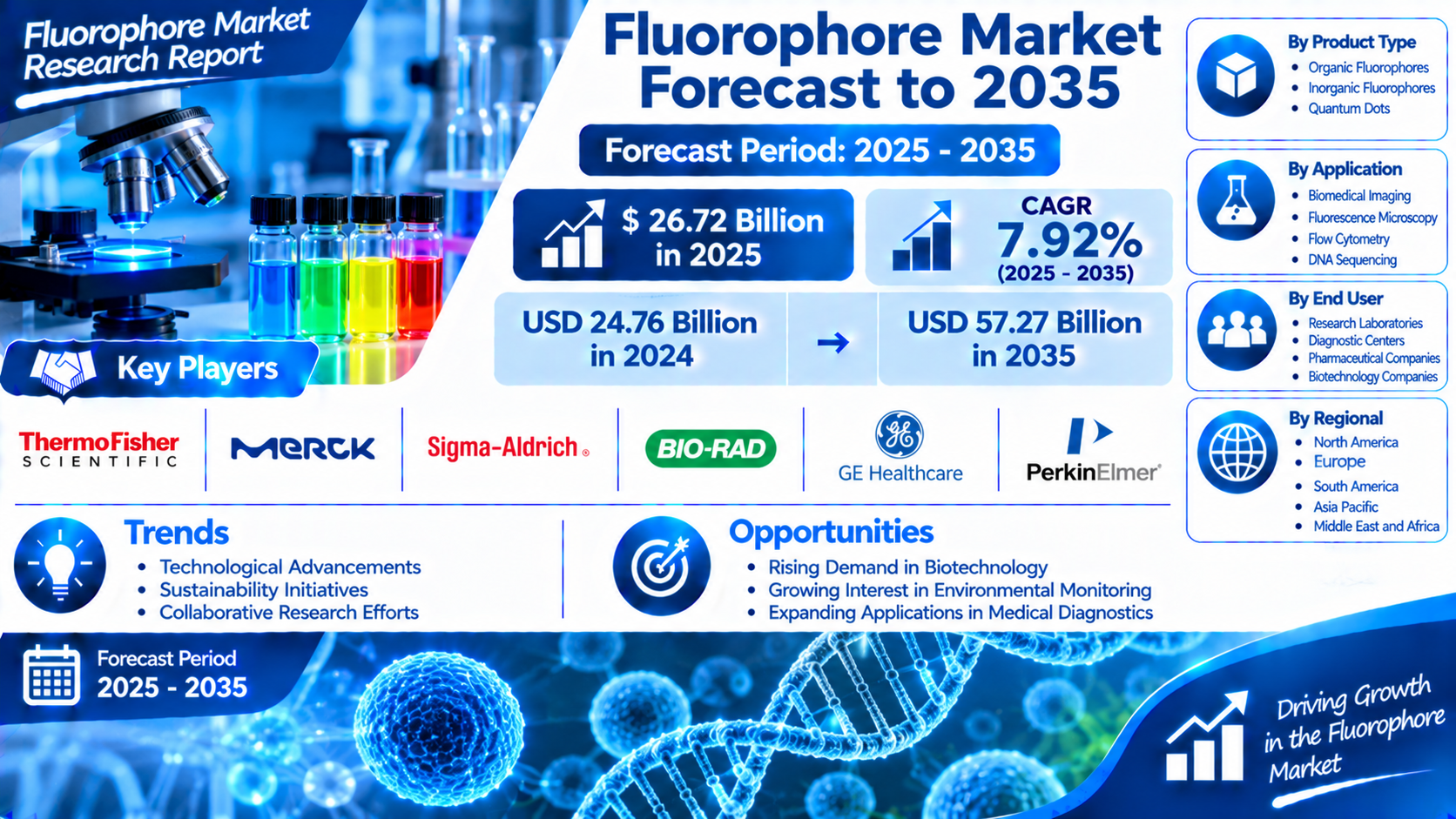

According to Market Research Future® (MRFR), the Fluorophore Market is expected to expand from USD 26.72 billion in 2025 to USD 57.27 billion by 2035, registering a compound annual growth rate (CAGR) of 7.92% during the forecast period from 2025 to 2035. The market was valued at USD 24.76 billion in 2024. Fluorophores are materials or molecules that absorb light at particular wavelengths and emit light at longer wavelengths. Their fluorescence properties make them important tools in scientific research, biological analysis, medical diagnostics, and imaging technologies. As laboratories and healthcare organizations increasingly rely on fluorescence-based techniques, demand for products that support sensitive detection and visualization is creating opportunities across the industry.
Fluorophores and Their Role in Scientific Applications
Fluorophores are widely used to identify, track, and visualize biological and chemical structures. Their ability to produce measurable fluorescent signals enables researchers to examine samples and observe processes that may not be readily visible through conventional techniques. These characteristics support applications in biomedical imaging, fluorescence microscopy, flow cytometry, and DNA sequencing.
In biomedical imaging, fluorescent materials help reveal cellular structures, tissue characteristics, and biological activity. Researchers and diagnostic professionals use fluorescence-based methods to obtain information from samples and support investigations into disease mechanisms. Fluorescence microscopy similarly relies on fluorescent labels and probes to distinguish specific structures within cells and other biological specimens. The resulting images can help researchers examine cellular organization and study interactions at a microscopic level.
Flow cytometry represents another important application. The technique uses fluorescent signals to identify and measure characteristics of individual cells as they pass through an instrument. Fluorophores with suitable optical properties can help distinguish different cell populations and support research and diagnostic workflows. DNA sequencing also uses fluorescent labeling in certain approaches, allowing genetic information to be detected through optical signals. These applications demonstrate why fluorophores remain relevant to research laboratories, diagnostic centers, pharmaceutical companies, and biotechnology companies.
Product Types and Market Segmentation
The market is segmented by product type into organic fluorophores, inorganic fluorophores, and quantum dots. Each category offers characteristics that can make it suitable for particular analytical, imaging, or research requirements. Product selection depends on factors such as fluorescence behavior, compatibility with the intended application, signal performance, and the requirements of the equipment and experimental method.
Organic fluorophores are used in a range of biological labeling and imaging applications. Their molecular structures can be selected or modified to support different excitation and emission characteristics. This flexibility makes them relevant to researchers working with cells, tissues, proteins, and other biological materials. Their use across established fluorescence techniques provides a foundation for continued demand.
Inorganic fluorophores form another product category. These materials can offer optical properties that are useful in specialized research and detection settings. Their suitability depends on the requirements of the application, including signal stability and compatibility with the surrounding sample or measurement system.
Quantum dots are also included in the product segmentation. These semiconductor-based nanomaterials are known for distinctive optical properties, including size-dependent emission characteristics. They have attracted interest for applications involving imaging, labeling, and detection. Their role in the market is connected to the need for fluorescent materials that can support increasingly specialized research methods.
Biomedical Imaging and Other Application Areas
Biomedical imaging is one of the identified application segments, reflecting the importance of fluorescence in visualizing biological structures and processes. Fluorescent probes can help researchers and healthcare professionals distinguish specific targets and examine samples. Continued research into imaging methods may create demand for products that offer application-specific optical characteristics.
Fluorescence microscopy is another established area of use. It enables researchers to study biological specimens by detecting emitted light from fluorescently labeled components. The method supports investigations in cell biology, microbiology, and other life science disciplines. As research workflows become more specialized, laboratories may require a broader selection of fluorophores suited to different experimental objectives.
Flow cytometry depends on fluorescent labeling to measure cellular properties. Its use in research and diagnostic settings supports demand for fluorophores that can be incorporated into analytical workflows. DNA sequencing adds another application area, where fluorescent signals can contribute to the detection and interpretation of genetic information. Together, these applications connect the fluorophore industry with several important areas of life science research and healthcare analysis.
End Users and Demand Conditions
Research laboratories represent a significant end-user category because fluorescence-based methods are central to many experimental workflows. Academic institutions, independent research facilities, and specialized laboratories use fluorophores to investigate biological systems, evaluate samples, and develop analytical methods. Their requirements can vary according to research objectives, available instruments, and the scale of laboratory activity.
Diagnostic centers use fluorescence technologies in selected testing and analytical procedures. The ability to detect specific signals can support the examination of biological samples and contribute to diagnostic workflows. Pharmaceutical companies also use fluorescence-based techniques during research and development activities, including investigations involving biological targets and compound behavior. Biotechnology companies apply these materials across research, product development, and analytical processes.
The diversity of end users helps broaden the market's demand base. However, purchasing decisions are influenced by the intended use, technical specifications, laboratory budgets, and compatibility with established equipment and procedures.
Key Market Trends and Opportunities
Technological advancements are an important trend shaping the fluorophore market. Improvements in fluorescence-related instruments, labeling approaches, and analytical techniques can increase the range of experiments and measurements supported by fluorescent materials. As research requirements become more precise, demand may develop for fluorophores designed for particular imaging and detection tasks.
Sustainability initiatives are also becoming relevant to the industry. Research organizations and manufacturers are increasingly considering resource use, waste management, and the environmental implications of laboratory operations. These considerations may influence product development, manufacturing practices, and procurement decisions.
Collaborative research efforts provide another avenue for market development. Partnerships among academic institutions, biotechnology companies, pharmaceutical organizations, and research laboratories can support the exchange of technical expertise and the development of new applications. Collaboration may also help connect material innovation with practical requirements in imaging and diagnostics.
Several opportunities are identified for the market. Rising demand in biotechnology can support the use of fluorophores in research, analytical testing, and development activities. Growing interest in environmental monitoring may create additional applications for fluorescent materials in detection and measurement processes. Expanding applications in medical diagnostics also offer potential for market development as fluorescence-based techniques are used in an increasing range of analytical workflows.
Competitive Landscape and Market Outlook
The key players identified in the fluorophore market include Thermo Fisher Scientific, Merck KGaA, Sigma-Aldrich, Bio-Rad Laboratories, GE Healthcare, and PerkinElmer. These companies are associated with scientific research products, laboratory technologies, analytical solutions, or healthcare-related offerings. Their presence reflects the connection between the fluorophore market and the broader life science and laboratory supply industries.
Competition is influenced by product characteristics, technical performance, portfolio breadth, application suitability, and the ability to serve different research and diagnostic requirements. As users adopt specialized fluorescence methods, suppliers may need to address demand for products that meet particular experimental and analytical needs.
The market's projected increase from USD 26.72 billion in 2025 to USD 57.27 billion in 2035, at a CAGR of 7.92%, indicates substantial expected expansion over the forecast period. Growth opportunities are linked to biotechnology demand, environmental monitoring interests, medical diagnostic applications, technological advancements, sustainability initiatives, and collaborative research. The combination of established laboratory uses and developing application areas positions fluorophores as important materials for scientific investigation and fluorescence-based analysis through 2035.

