

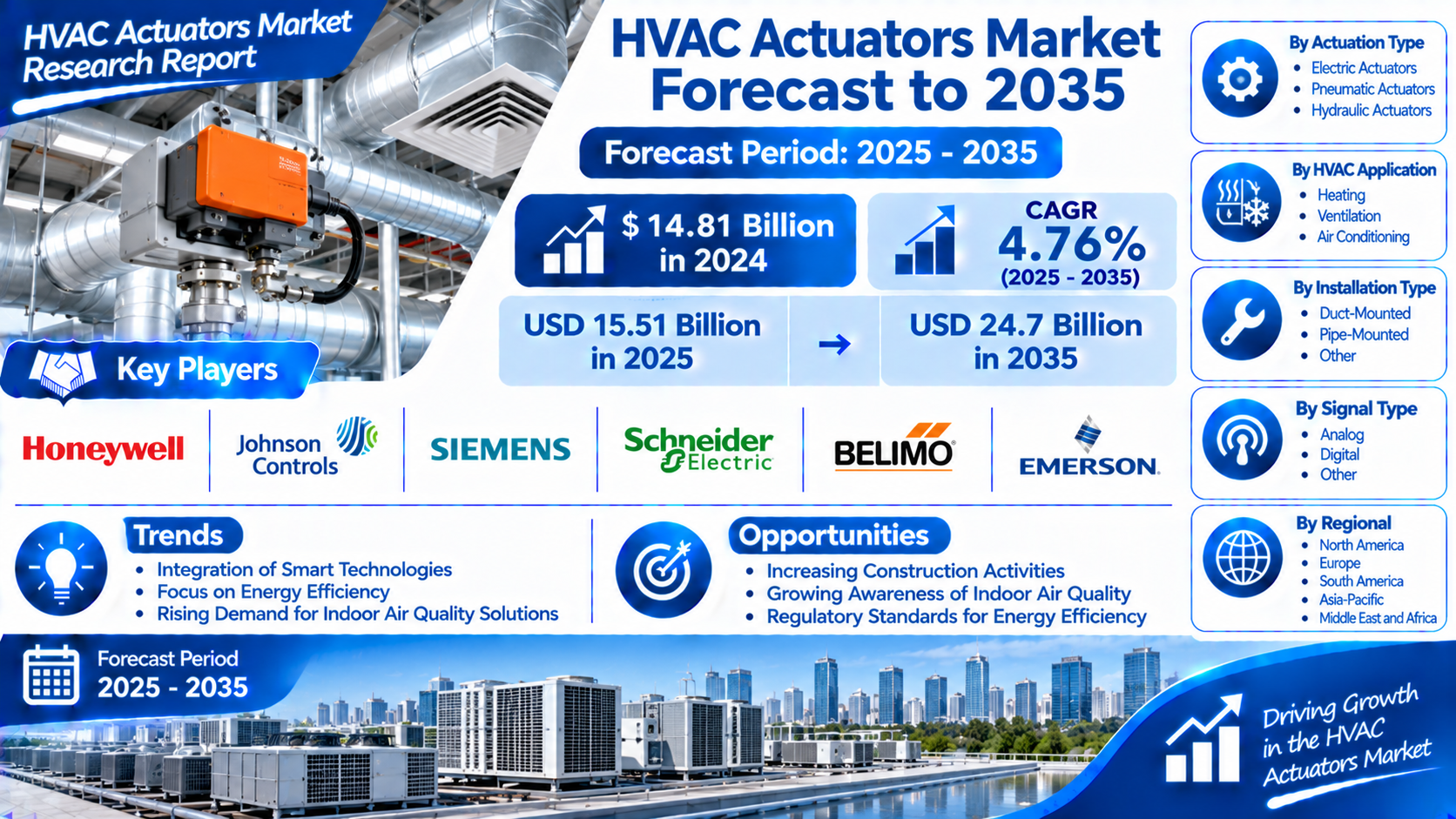

According to Market Research Future® (MRFR), the HVAC Actuators Market is forecast to reach USD 24.7 billion by 2035, rising from USD 15.51 billion in 2025. The market is expected to record a CAGR of 4.76% between 2025 and 2035, following a valuation of USD 14.81 billion in 2024. HVAC actuators enable heating, ventilation, and air conditioning systems to respond to control instructions by moving or adjusting mechanical components. Their use supports functions such as airflow regulation and valve control, connecting the actuator industry with building automation, energy management, and indoor environmental quality.
How HVAC Actuators Support Building Climate Control
Heating, ventilation, and air conditioning systems depend on coordinated mechanical and electronic components to maintain desired indoor conditions. Actuators provide the movement needed to operate selected parts of these systems. They can adjust dampers, valves, and other mechanisms based on instructions received from a control unit. This allows HVAC equipment to change its operation in response to temperature settings, airflow requirements, or other system inputs.
The importance of this function becomes clear in buildings with multiple rooms or zones. Different areas may have different heating, cooling, and ventilation requirements. Actuators help translate control signals into physical adjustments, supporting the operation of equipment across these spaces. Their role is not limited to one part of the HVAC process, as the market covers heating, ventilation, and air conditioning applications.
In heating systems, actuators can operate components involved in regulating heat distribution. Ventilation applications use actuators to control airflow-related mechanisms, while air conditioning systems may rely on them for adjustments involving valves and dampers. The actuator must be suited to the equipment and the control arrangement in which it is installed.
Electric, Pneumatic and Hydraulic Actuation
Actuation type is a primary market segmentation. Electric actuators use electrical energy to produce movement and can work with electronic control systems. Their application is relevant to HVAC installations that use automated controls and building-management technologies. As smart systems become more integrated, compatibility between electric actuators and digital control infrastructure is an important product consideration.
Pneumatic actuators operate through compressed air. Their use depends on the availability and design of pneumatic infrastructure within the installation. They provide an alternative to electrically powered mechanisms in systems configured for pneumatic operation.
Hydraulic actuators use pressurized fluid to generate mechanical movement. Their suitability depends on the requirements of the controlled equipment and the operating conditions of the installation. Each actuation category offers a different operating approach, so buyers consider system design, control requirements, installation conditions, and the characteristics of the mechanism being operated when selecting products.
The presence of all three categories reflects the variety of HVAC installations in the market. Manufacturers must address different technical configurations and ensure that actuator products are compatible with the equipment and control systems used by customers.
Installation Formats and Control Signals
The market is also segmented by installation type into duct-mounted, pipe-mounted, and other installations. Duct-mounted actuators are used in connection with ductwork and airflow-control equipment. Their role can include operating dampers that regulate the movement of air through a building. Pipe-mounted actuators are associated with components installed in piping systems, where controlled movement can support HVAC system operation.
The other installation category covers applications outside the two specified formats. Installation conditions can influence product design and selection, particularly where available space, mounting requirements, accessibility, and the configuration of connected equipment differ.
Signal type provides another distinction, with analog, digital, and other signals included in the segmentation. Analog signals communicate control information through varying values, whereas digital signals use discrete formats. Actuators need to receive and interpret signals compatible with the control architecture of the HVAC system. This makes signal type relevant to integration, commissioning, and the coordination of different building-management components.
Smart Buildings and Energy-Conscious Operation
Integration of smart technologies is one of the key trends in the HVAC actuators market. Building automation connects HVAC equipment with sensors, controllers, and monitoring systems. Actuators form the mechanical link between these instructions and the physical operation of valves, dampers, and other components.
As building systems become more connected, the ability to coordinate equipment operation becomes increasingly important. Smart controls can help adjust HVAC settings according to changing building conditions. Actuators that integrate effectively with the selected control system can support these automated functions. Their contribution depends on the complete system design and the accuracy of the control strategy.
Energy efficiency is another major focus. Heating and cooling requirements can vary throughout the day and across different areas of a building. HVAC systems that respond to these changing needs can avoid operating components in ways that do not match demand. Actuators support this process by enabling controlled mechanical adjustments. Their role is part of a wider efficiency approach that also depends on equipment performance, building design, maintenance, and system configuration.
Indoor Air Quality as a Demand Driver
The rising demand for indoor air quality solutions is an important trend for the market. Ventilation systems help manage the movement of indoor and outdoor air, making airflow control relevant to the quality of indoor environments. Actuators can operate ventilation components, allowing systems to adjust airflow according to control instructions.
Growing awareness of indoor air quality also creates an identified market opportunity. Building owners and facility managers may invest in ventilation improvements as part of efforts to address occupant comfort and indoor environmental requirements. Such projects can support demand for actuators used in new HVAC installations and upgrades.
The opportunity extends across different building types, although the specific actuator requirements depend on the ventilation design and control system. Product compatibility, installation conditions, and the performance of the complete HVAC system remain important factors in determining adoption.
Construction Activity and Energy Regulations
Increasing construction activities provide another source of potential demand. New buildings require HVAC infrastructure suited to their intended use, size, and operating requirements. Commercial and other building projects can create opportunities for actuator suppliers as heating, ventilation, and air conditioning systems are specified and installed.
Regulatory standards for energy efficiency are also identified as an opportunity. Energy-related requirements can encourage building owners, developers, and facility operators to consider equipment and controls that support more efficient operation. HVAC actuators can form part of these control arrangements by enabling adjustments to mechanical components. The market opportunity depends on how standards are implemented and how building projects respond through equipment selection and system design.
Key Companies and Competitive Considerations
The key players identified in the market include Honeywell, Johnson Controls, Siemens, Schneider Electric, Belimo, and Emerson. These companies operate in areas connected to automation, building systems, electrical technologies, and control solutions. Their participation reflects the role of HVAC actuators within a wider ecosystem of building equipment and industrial technologies.
Competition is shaped by the ability to serve different actuation technologies, installation formats, and signal requirements. Product reliability, control compatibility, ease of installation, and suitability for specific HVAC applications can influence customer decisions. The integration of smart technologies also makes coordination with broader building-management systems an important consideration.
Forecast and Industry Direction
The HVAC actuators market is projected to expand from USD 15.51 billion in 2025 to USD 24.7 billion by 2035, representing a CAGR of 4.76% over the forecast period. Electric, pneumatic, and hydraulic actuators serve different system configurations, while duct-mounted, pipe-mounted, and other installation formats address varied equipment requirements.
The market's direction is connected to smart technology integration, energy efficiency, and demand for indoor air quality solutions. Construction activity and energy-efficiency regulations provide additional opportunities. As building operators focus on automated control and more responsive climate-management systems, actuators will continue to serve as important components linking HVAC control signals with mechanical operation.

