

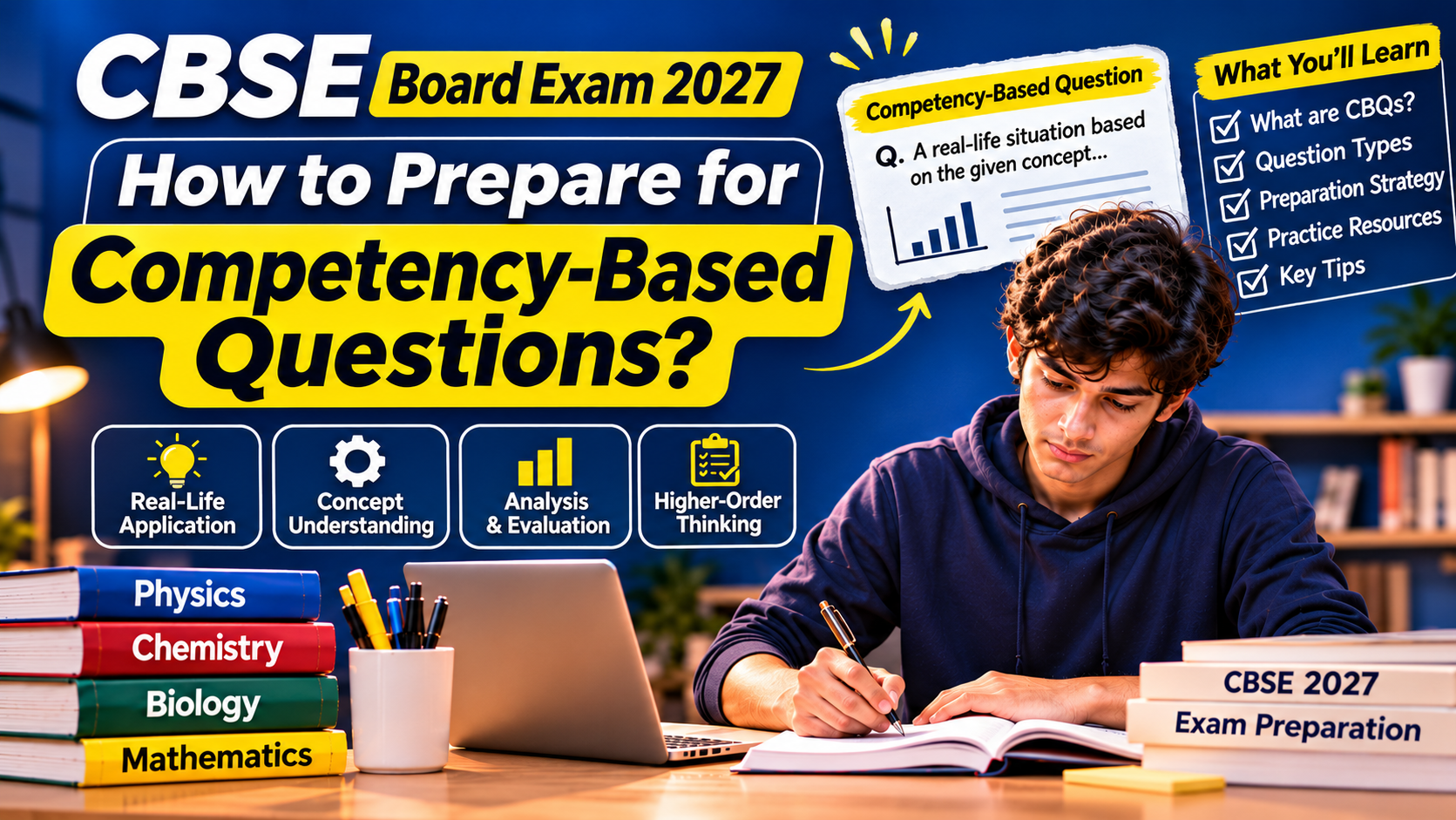

Ask any Class 10 or Class 12 student what worries them most about board exams, and you will often hear the same answer: “What if the question is not from the book?” That fear is exactly why competency-based questions have become the most talked-about feature of the CBSE paper pattern. With the 2027 boards approaching, understanding this format is no longer optional. It is a core part of scoring well.
The good news is that these questions are not a trick. They reward students who genuinely understand what they study, and that skill can be built with the right habits. Many parents and students in Rajasthan are already reassessing how they study, and choosing the Best CBSE School in Sikar can make a real difference when teachers actively train children in application-based thinking from the middle school years onwards.
What Exactly Are Competency-Based Questions?
A competency-based question checks whether you can use what you have learned in a fresh situation. Instead of asking you to define photosynthesis, it might describe a farmer whose greenhouse plants are turning yellow and ask you to reason out the likely cause using what you know about light, chlorophyll, and gas exchange.
These questions usually appear as:
-
Case studies and real-life scenarios
-
Source-based passages, maps, or extracts
-
Data tables, graphs, and diagrams to interpret
-
Assertion-reason and multi-step reasoning questions
-
Situation-based problems in mathematics and science
The idea flows from the National Education Policy 2020, which pushes schools away from rote memorisation and towards critical thinking, analysis, and problem solving.
Why CBSE Is Increasing Its Weightage
CBSE has steadily raised the share of competency-focused questions over the last few academic sessions. For Classes 9 to 12, the board’s recent circulars have placed roughly half of the paper in this category, with the remainder split between objective-type questions and traditional constructed-response answers. Because patterns can be revised, always cross-check the current sample papers and marking schemes on the official CBSE academic website before finalising your plan.
The reasoning is simple. Employers, universities, and entrance examinations such as CUET, JEE, and NEET already demand application skills. Board exams are being aligned with that reality.
Traditional vs Competency-Based Questions: A Quick Comparison
|
Feature |
Traditional Question |
Competency-Based Question |
|
Core demand |
Recall of facts and definitions |
Application, analysis, and reasoning |
|
Format |
Direct, textbook-style |
Scenario, case study, data, or passage |
|
Answer source |
Often lifted from NCERT lines |
Constructed through understanding |
|
Preparation method |
Memorising and rewriting |
Concept clarity and varied practice |
|
Common mistake |
Forgetting a definition |
Misreading the context given |
|
Skill measured |
Memory |
Thinking and transfer of learning |
A Smart Preparation Plan for CBSE 2027
1. Rebuild Your Foundation with NCERT
Competency-based questions may look unfamiliar, but their raw material is still the syllabus. Read NCERT chapters slowly, including the examples, activity boxes, and “think about it” sections that many students skip. These sections quietly train the reasoning style the board now tests.
After finishing a topic, close the book and explain it aloud in your own words. If you cannot explain why something happens, you have not yet learned it.
2. Ask “Where Would This Be Used?”
For every concept, spend two minutes linking it to daily life. Percentages become discounts and loan interest. Chemical reactions show up in rusting iron and cooking. Democracy and federalism appear in news headlines about elections and state-centre relations. This habit turns abstract chapters into usable knowledge.
3. Practise Case-Based Questions Early
Do not wait until the final months. Start solving two or three case-based questions per subject every week from the beginning of the preparation cycle. Sources worth using:
-
CBSE’s official sample papers and marking schemes
-
Previous years’ board papers
-
Question banks released by the board
-
Quality school-prepared worksheets
4. Learn to Read Before You Solve
Many marks are lost not because the concept is unknown, but because the passage was skimmed. Try this three-step reading routine:
-
Read the question first, so you know what to look for.
-
Read the passage or data, underlining key numbers and keywords.
-
Re-read the question and then write your answer.
This small discipline can add several marks across a paper.
5. Strengthen Subject-Specific Skills
Each subject asks for something slightly different:
-
Mathematics: Translate word problems into equations; practise real-world contexts like mensuration in construction or probability in games.
-
Science: Interpret experiment descriptions, graphs, and observation tables; revise reasons behind every law rather than the law alone.
-
Social Science: Learn to read maps, cartoons, and source extracts; link historical causes to consequences.
-
English: Work on inference, tone, and vocabulary in context rather than only grammar rules.
-
Languages and Commerce subjects: Practise unseen passages and situation-based questions, such as accounting or economics scenarios.
6. Build a Mistake Journal
Keep a notebook where you log every wrong answer, the reason it went wrong, and the correct reasoning. Common categories include misreading, concept gap, calculation slip, and weak presentation. Reviewing this journal weekly is one of the fastest ways to improve, because you stop repeating the same errors.
7. Time Your Practice
Competency questions are lengthier, so time management matters. Once a week, attempt a full paper in exam conditions. Track how long case-based sections take and adjust your pace. A useful target is to finish the paper with ten minutes left for revision.
Common Mistakes Students Should Avoid
-
Relying only on guides that offer “ready answers”
-
Ignoring diagrams, graphs, and data tables
-
Writing long, unfocused answers when a precise one scores better
-
Leaving case-based questions for the end and running out of time
-
Skipping practice because “the concept is clear”
-
Studying in isolation without feedback from teachers
How Schools and Parents Can Help
A student’s preparation improves dramatically when school and home work in the same direction. Teachers can design classroom activities, debates, and projects that require reasoning. Parents can support by asking open-ended questions at home, such as “Why do you think this happens?” instead of “Did you finish the chapter?” Encouraging curiosity builds the exact mindset these questions reward.
A Sample Weekly Study Rhythm
|
Day |
Focus Area |
Activity |
|
Monday |
Mathematics |
Concept revision plus 5 word problems |
|
Tuesday |
Science |
NCERT reading plus 2 case studies |
|
Wednesday |
Social Science |
Source-based questions and map work |
|
Thursday |
English/Language |
Unseen passage and inference practice |
|
Friday |
Weak subject |
Targeted revision from mistake journal |
|
Saturday |
Mock test |
Timed section or full paper |
|
Sunday |
Review |
Analyse errors and plan the next week |
Adjust this schedule to your strengths. The aim is balance and regularity rather than perfection.
Conclusion
Competency-based questions can feel intimidating at first, but they are really an invitation to show what you understand. Students who read carefully, connect ideas to the real world, and practise consistently tend to find these questions more engaging than traditional ones. Begin early, stay curious, and treat every mistake as information. With steady effort, the 2027 board paper can become an opportunity rather than an obstacle.
FAQs
Q1. What are competency-based questions in CBSE?
Competency-based questions test whether students can apply concepts to unfamiliar, real-life situations rather than recall textbook lines. They often use case studies, data, passages, or scenarios requiring reasoning and analysis.
Q2. Are competency-based questions only for Class 10 and 12?
No. CBSE has been rolling them out across Classes 6 to 12 under NEP 2020, though the proportion differs by class. Boards 2027 papers carry a substantial share of them.
Q3. Is NCERT enough to prepare for these questions?
NCERT remains the foundation, since most questions are built on its concepts. However, you should practise application-based questions, sample papers, and previous years’ papers to learn how concepts are tested.
Q4. How many hours should I practise daily?
Aim for two to three focused hours of daily practice, split between concept revision and application questions. Consistency matters more than marathon sessions, so review your mistakes carefully every week.
Q5. Do competency-based questions make the paper harder?
Not necessarily harder, but certainly different. Students who understand concepts deeply find them manageable, while those who rely on rote learning struggle because answers cannot be copied directly from textbooks.

