

Paper Carrier Bags Market Opportunities Across Retail, Food and Beverage, and E-commerce

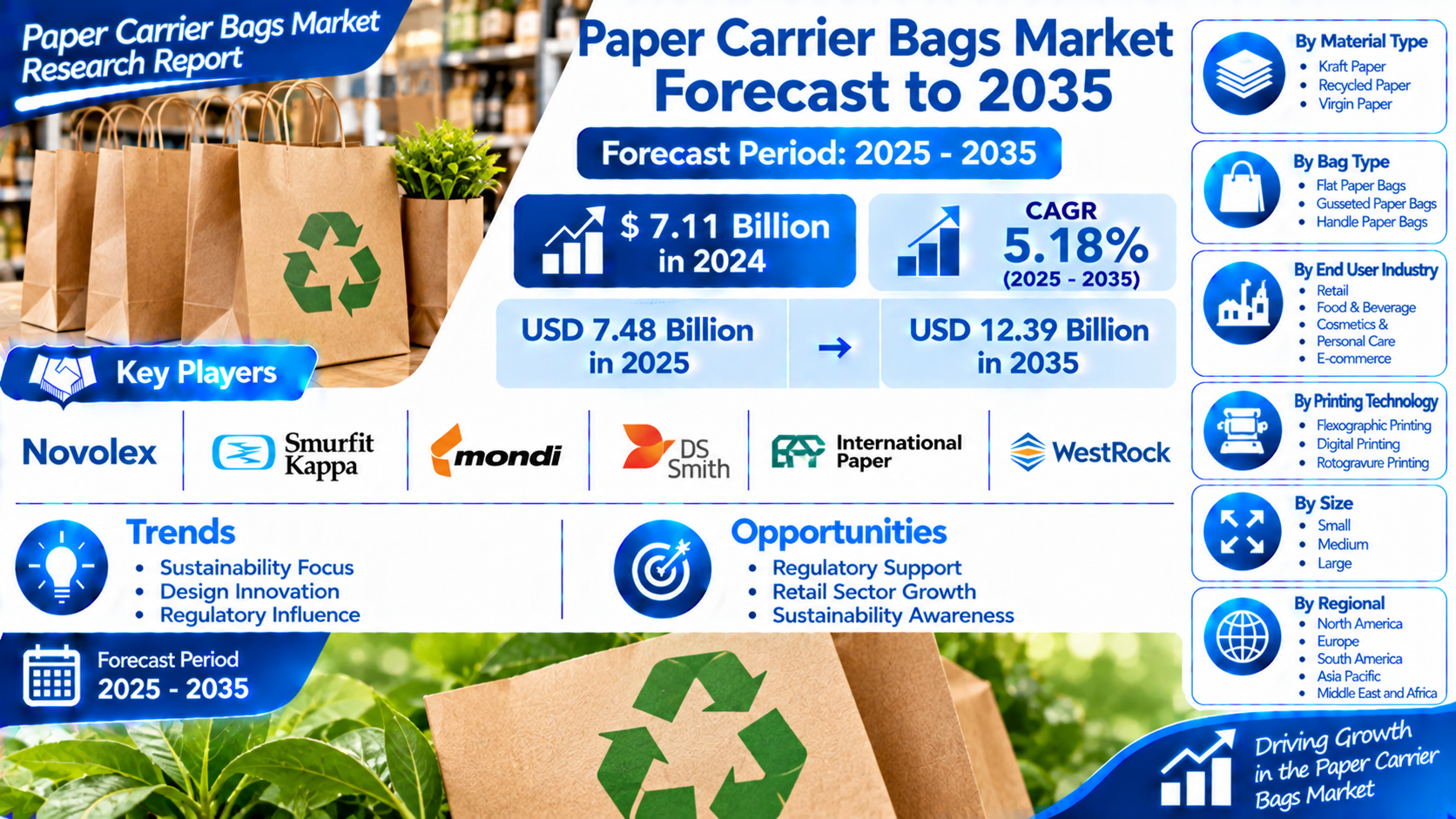
According to Market Research Future® (MRFR), the Paper Carrier Bags Market is expected to record consistent growth between 2025 and 2035 as sustainability awareness, design innovation, and regulatory influence shape the packaging landscape. The market reached USD 7.11 billion in 2024 and is estimated at USD 7.48 billion in 2025. It is forecast to attain USD 12.39 billion by 2035, registering a CAGR of 5.18% over the forecast period. The market's segmentation across materials, bag configurations, end-user industries, printing technologies, and product sizes demonstrates the range of requirements addressed by paper carrier bag suppliers.
A Market Shaped by Changing Packaging Priorities
Paper carrier bags occupy a position across several commercial activities, particularly where businesses need bags for customer purchases and product carrying. Retail, food and beverage, cosmetics and personal care, and e-commerce are the four end-user industries included in the market segmentation. Their presence gives the industry a diverse demand base, with each category bringing its own product and presentation requirements.
The market's growth outlook is supported by three identified themes: sustainability focus, design innovation, and regulatory influence. Sustainability awareness is creating an opportunity for paper carrier bags as businesses and customers pay attention to packaging materials. Regulatory considerations also influence the environment in which packaging manufacturers operate. These factors place material selection and product development at the center of the industry's long-term outlook.
The projected increase from USD 7.48 billion in 2025 to USD 12.39 billion in 2035 suggests that the market is expected to build on its existing commercial base. A CAGR of 5.18% over the 2025–2035 period indicates a measured growth trajectory rather than a short-term expansion limited to one application or product category.
Material Selection and Bag Design
Material type is a defining segment of the paper carrier bags market. The three categories are kraft paper, recycled paper, and virgin paper. These materials provide manufacturers with different choices when developing products for their customers. Material requirements can vary according to the intended use, product design, and preferences of the purchasing business.
The sustainability focus identified in the market trends makes material selection especially relevant. Recycled paper is a distinct category in the market, while kraft paper and virgin paper provide additional options. Manufacturers can use this range to develop portfolios that address different customer specifications. Sustainability awareness also creates an opportunity for companies to communicate material choices and product characteristics to buyers.
Bag configuration adds another dimension to product differentiation. Flat paper bags, gusseted paper bags, and handle paper bags are the three identified bag types. Each format represents a different design approach within the market. The availability of multiple configurations allows suppliers to serve customers with varied carrying and packaging requirements.
Design innovation can support the development of these formats. Businesses may evaluate bag structure, appearance, and usability when selecting products for their operations. Manufacturers that maintain a varied product range can address different needs across the retail, food and beverage, cosmetics and personal care, and e-commerce sectors.
End-User Demand and Commercial Applications
The retail sector is an important part of the market's demand structure and is also identified as a growth opportunity. Retail businesses use carrier bags as part of the customer purchasing experience. Different retailers may require different sizes, materials, and printed designs, creating opportunities for manufacturers to offer product variations.
Food and beverage companies form another end-user group. Their requirements contribute to demand for carrier bags designed for commercial product handling and customer purchases. Cosmetics and personal care businesses also appear in the segmentation. In this category, the appearance and presentation of packaging can be relevant to product and brand positioning, making design options an important consideration.
E-commerce is the fourth identified end-user industry. Its inclusion highlights the role of paper carrier bags within a wider commercial environment that includes both physical retail and online purchasing. Businesses serving e-commerce customers may assess packaging according to their distribution and customer requirements.
The combination of these industries reduces the market's dependence on one specific end-use category. It also creates opportunities for suppliers to develop customer relationships across different commercial sectors. Retail sector growth and sustainability awareness are particularly relevant opportunities identified for the market.
Printing Technology and Size Segmentation
Printed designs are an important part of the product offering, and the market includes three printing technologies: flexographic printing, digital printing, and rotogravure printing. These technologies form part of the manufacturing landscape and support the range of printed paper carrier bags available to customers.
Design innovation is a stated market trend, making printing technology relevant to product differentiation. Businesses may seek bags that align with their presentation requirements, while manufacturers must consider how their printing capabilities support different designs and production needs. The three identified technologies provide a framework for understanding this segment of the industry without limiting the market to a single printing approach.
Size is another practical consideration in product selection. The market is divided into small, medium, and large bags. These categories allow suppliers to address different carrying requirements across the end-user industries. A retailer, food and beverage business, or cosmetics company may require a different size depending on the products being carried. The availability of multiple sizes therefore contributes to the breadth of the market's product offering.
Regional Coverage and Key Companies
The market's regional segmentation includes North America, Europe, South America, Asia Pacific, and the Middle East and Africa. These regions represent the geographic scope covered by the market. The inclusion of multiple regions provides a broad view of the industry and reflects the international presence of paper carrier bag demand and supply.
Key companies identified in the market include Novolex, Smurfit Kappa, Mondi Group, DS Smith, International Paper, and WestRock. Their participation forms part of the competitive landscape. Companies in this market operate within an environment where material options, bag designs, printing capabilities, and customer requirements are important dimensions of product positioning.
Outlook to 2035
The market's future development will be influenced by the interaction of sustainability awareness, regulatory influence, retail activity, and design innovation. Regulatory support is identified as an opportunity, while sustainability focus and design innovation are recognized as trends. These themes point to continued attention toward materials and product characteristics.
For manufacturers, the opportunity lies in addressing a broad range of customer requirements through suitable material choices, bag formats, printing technologies, and sizes. Retail sector growth offers an additional avenue for market development, while sustainability awareness may keep packaging choices prominent in business decisions.
With market value forecast to rise from USD 7.48 billion in 2025 to USD 12.39 billion by 2035, the paper carrier bags industry is positioned for continued expansion. The projected CAGR of 5.18% across 2025–2035 provides a clear measure of the expected growth and underlines the market's relevance across multiple end-user industries and regions.

