

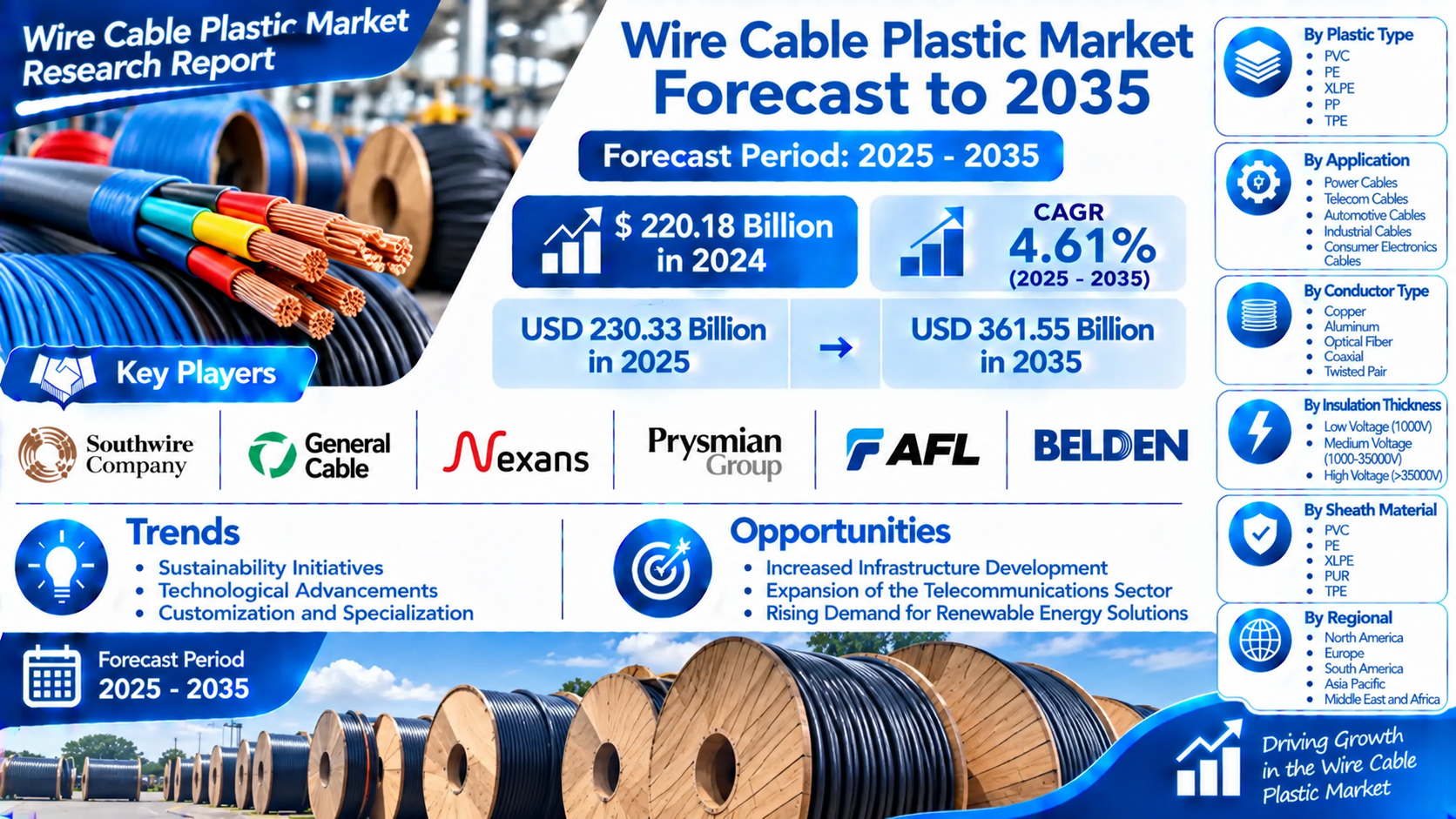

The global Wire Cable Plastic market is expected to record consistent growth through 2035 as investment in infrastructure, communication networks and renewable energy solutions supports demand for wire and cable products. According to Market Research Future® (MRFR), the Wire Cable Plastic Market was valued at USD 220.18 billion in 2024 and is projected to reach USD 230.33 billion in 2025. The market is forecast to attain USD 361.55 billion by 2035, representing a CAGR of 4.61% during 2025–2035. Its segmentation across materials, applications, conductor types, insulation thickness and sheath materials reflects the range of requirements across electrical, industrial and communication systems.
Market Performance and Demand Drivers
Wire and cable products are used across sectors that depend on electrical power, communication and connected equipment. Plastic materials form part of the market's product structure through categories covering cable composition and sheathing. Demand is therefore linked to activity across multiple industries rather than a single application.
The market's projected increase from USD 230.33 billion in 2025 to USD 361.55 billion in 2035 indicates a sustained growth outlook. The reported CAGR of 4.61% reflects the expected expansion over the forecast period. Increased infrastructure development, expansion of the telecommunications sector and rising demand for renewable energy solutions are identified as key opportunities.
These opportunities are reinforced by three industry trends: sustainability initiatives, technological advancements, and customization and specialization. Together, they highlight the importance of material development and application-specific products as the market evolves.
Material Portfolio: PVC, PE, XLPE, PP and TPE
The plastic type segmentation includes PVC, PE, XLPE, PP and TPE. These five categories provide the foundation for analyzing material demand within the market. Each is included as a distinct segment in the report, reflecting the variety of plastics used in wire and cable products.
Material selection is relevant to manufacturers serving different cable applications. Power, telecommunications, automotive, industrial and consumer electronics cables may involve different product specifications. The range of listed plastic types provides a framework for assessing how suppliers address those requirements.
The report does not provide individual material shares, technical comparisons or detailed performance characteristics. It is therefore not possible to determine which plastic type has the largest market contribution or the fastest growth. The available segmentation establishes the principal material categories without supporting a ranking.
Cable Applications Across Key Industries
Five application segments are covered: power cables, telecom cables, automotive cables, industrial cables and consumer electronics cables. This distribution connects the market to a broad range of infrastructure and manufacturing activities.
Power cables are relevant to electricity infrastructure, while telecom cables serve communication requirements. Automotive and industrial cables address other specialized application areas, and consumer electronics cables represent an additional category within the market.
The diversity of applications creates opportunities for manufacturers to develop products for different customer requirements. Infrastructure investment can support demand for power and industrial cable systems, while telecommunications expansion can increase requirements for communication-related products. The supplied data does not provide application-level revenue or forecast growth rates, so the relative contribution of each category remains unspecified.
Conductor Categories and Voltage Requirements
The conductor type segmentation comprises copper, aluminum, optical fiber, coaxial and twisted pair. These categories represent the range of conductor and cable formats covered by the report. Their inclusion reflects the different requirements associated with electrical transmission and communication applications.
The market is also classified by insulation thickness into low voltage (1000V), medium voltage (1000-35000V) and high voltage (>35000V). This structure allows the market to be assessed across different voltage categories and related product requirements.
Infrastructure development and renewable energy demand are relevant to this segmentation because electrical projects can require cable systems across different voltage levels. However, the supplied specifications do not quantify demand by voltage category or identify which conductor type leads the market. These categories should therefore be treated as the report's segmentation framework rather than a ranking of market performance.
Sheath Materials and Customization
The sheath material categories are PVC, PE, XLPE, PUR and TPE. This segmentation provides another view of the plastic materials used within wire and cable products. It also shows how the market distinguishes between overall plastic types and materials specifically classified for cable sheathing.
Customization and specialization are identified as key market trends. As cable applications vary, suppliers may need to adapt product offerings to different conductor formats, insulation requirements and sheath specifications. This creates scope for specialized products serving particular industries and operating requirements.
The supplied data does not detail individual sheath applications or provide technical comparisons among PVC, PE, XLPE, PUR and TPE. It does, however, identify sheath material as a distinct market dimension, reinforcing the importance of product specification and material choice.
Sustainability and Technology Development
Sustainability initiatives are among the major trends shaping the market. The focus on sustainability may influence material development and manufacturing priorities as companies respond to changing expectations across infrastructure and industrial sectors. The report does not specify particular sustainability standards or identify individual materials as environmentally preferred.
Technological advancements are another important trend. Innovation can support the development of cable materials and product configurations suited to evolving application requirements. The available specifications do not name specific technologies, but the trend indicates that product and process development remain relevant to market participants.
Customization and specialization connect these trends with customer requirements. Suppliers may need to balance material considerations with the technical and application-specific demands of cable users. This makes product development an important area of competition.
Growth Opportunities in Infrastructure and Telecommunications
Increased infrastructure development is a major opportunity for the market. Infrastructure projects can require cable products for power and related systems, supporting demand across several application and voltage categories. The scale and nature of infrastructure investment may influence the types of products required.
Expansion of the telecommunications sector is another opportunity. As communication networks develop, demand for telecom cable products may create further market opportunities. The inclusion of optical fiber, coaxial and twisted pair in the conductor segmentation demonstrates the range of cable categories covered by the report.
Rising demand for renewable energy solutions provides a third opportunity. Renewable energy development requires supporting infrastructure, creating potential demand for electrical cable systems. The report identifies this opportunity but does not quantify its contribution to market growth or specify particular technologies and projects.
Regional Coverage and Competitive Landscape
The market's regional segmentation includes North America, Europe, South America, Asia Pacific, and the Middle East and Africa. Regional development may depend on infrastructure investment, telecommunications expansion, industrial activity and renewable energy demand. No regional market shares or country-level forecasts are included in the supplied data.
The key players profiled are Southwire Company, General Cable, Nexans, Prysmian Group, AFL and Belden Inc. These companies are identified as participants in the competitive landscape. The available specifications do not provide market-share figures, company rankings or individual strategic initiatives.
Outlook to 2035
The Wire Cable Plastic Market is forecast to increase from USD 220.18 billion in 2024 to USD 230.33 billion in 2025 and USD 361.55 billion by 2035. The projected CAGR is 4.61% during 2025–2035. Demand from infrastructure development, telecommunications expansion and renewable energy solutions provides several opportunities for market participants.
Sustainability initiatives, technological advancements and customization are expected to remain important considerations. With the market spanning multiple plastic types, cable applications, conductor categories, voltage levels and sheath materials, manufacturers will continue to address varied product requirements across the industries served.

