

Industry 4.0 Market: Key Drivers, Competitive Landscape, and Emerging Industry Trends

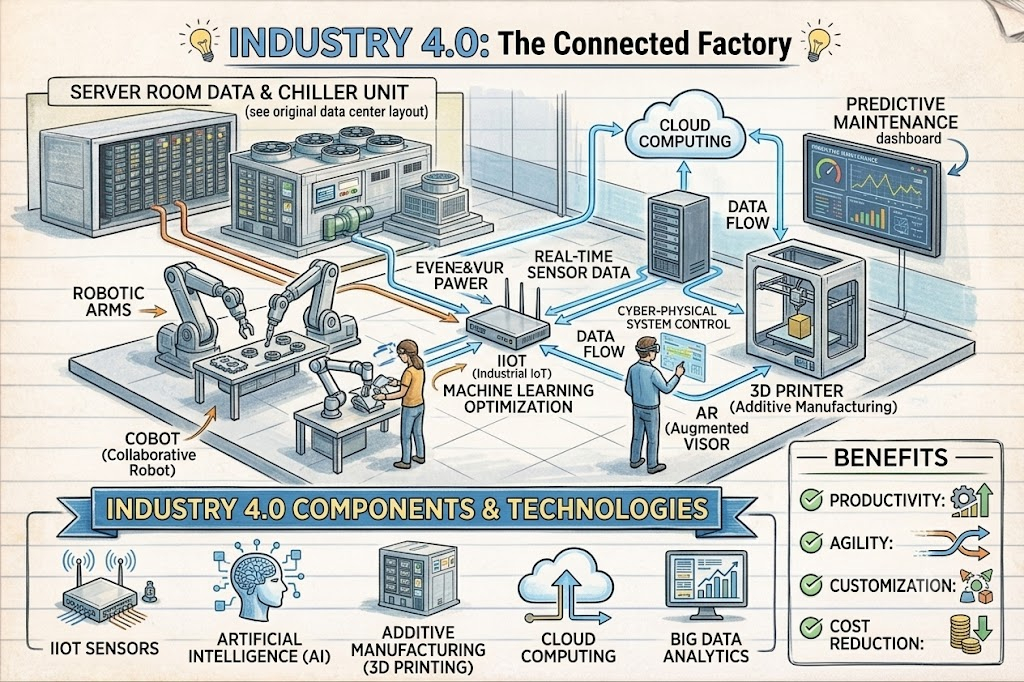
Global manufacturing enterprises are dismantling isolated mechanical assembly lines in favor of interconnected, autonomous production ecosystems capable of self-optimization. Participants engaging in collaborative discussions regarding the fourth industrial revolution must evaluate how cyber-physical systems, edge analytics, and industrial robotics redefine shop-floor agility and supply chain visibility. A thorough review of the Industry 4.0 Market analysis demonstrates that industrial leaders increasingly rely on sensor-driven telemetry to eliminate unplanned equipment downtime and customize mass production at scale. Conventional factories operate with rigid automation sequences and periodic manual inspections, whereas smart factories establish continuous digital threads linking customer orders directly to autonomous machine tools. Group discussions often highlight how this architectural shift alters workforce responsibilities, transitioning human operators from repetitive physical assembly toward supervisory roles managing digital dashboards and predictive maintenance workflows.
Beyond immediate shop-floor productivity gains, the structural hurdles of brownfield modernization and IT-OT convergence dictate enterprise transformation speed. Stakeholders must address the reality that roughly 70 percent of global manufacturing machinery is over fifteen years old and lacks native Internet Protocol connectivity. Industry evaluations indicate that retrofitting legacy CNC machines and hydraulic presses with non-invasive edge gateways is essential for unlocking real-time operational visibility without prohibitive capital replacement costs. As factories connect operational technology to enterprise cloud networks, participants should examine how industrial cybersecurity frameworks protect critical physical infrastructure against ransomware and unauthorized remote manipulation.
Frequently Asked Questions
-
What defines the transition to smart manufacturing under Industry 4.0? It represents the integration of cyber-physical systems, Industrial Internet of Things (IIoT) sensors, artificial intelligence, and cloud computing to create autonomous, self-optimizing factories.
-
Why is brownfield legacy integration a major challenge for manufacturers? Approximately 70 percent of existing industrial equipment lacks built-in digital connectivity, requiring specialized edge sensors and protocol converters to stream operational data.
➤➤➤Explore MRFR’s Related Ongoing Coverage In Semiconductor Industry:
Uk Generative Ai In Fintech Market
Us Near Field Communication Market
Germany Ground Penetrating Radar Market
Us Ground Penetrating Radar Market

