

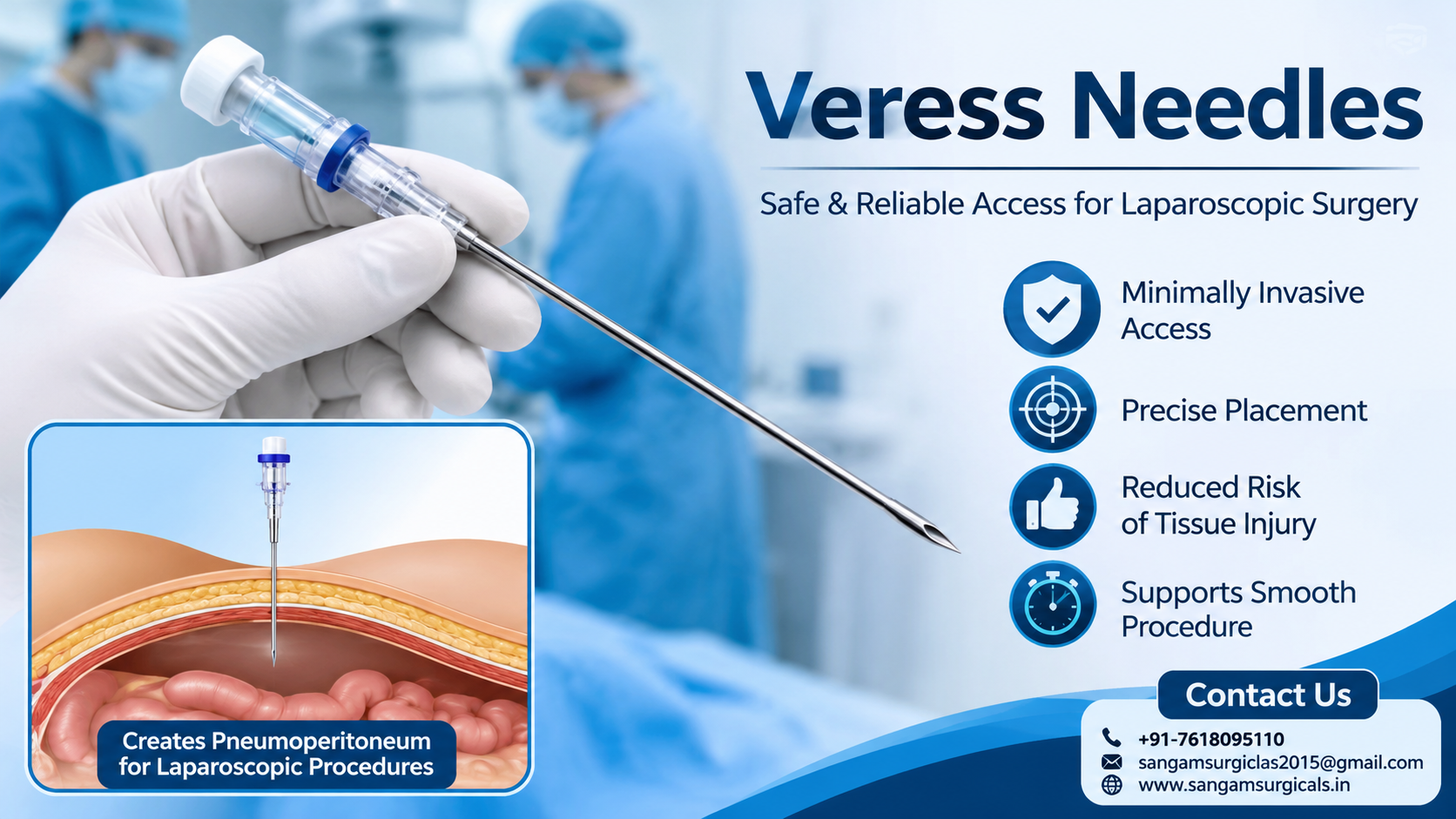

Modern healthcare institutions require surgical instruments that meet demanding functional and quality requirements. Even minor manufacturing defects in laparoscopic instruments can affect their mechanical performance. Therefore, manufacturers must pay attention to material selection, dimensional accuracy, component assembly and product inspection.
High-quality Veress Needles incorporate several precision-engineered components that support their intended function during laparoscopic procedures. Understanding how these instruments are manufactured helps healthcare buyers evaluate product quality beyond appearance and pricing.
Why Manufacturing Quality Matters in Laparoscopy
Laparoscopic instruments often contain small mechanical components that must function together under specific conditions. Their performance depends on manufacturing accuracy and appropriate material selection.
A poorly manufactured instrument may develop mechanical resistance, dimensional inconsistencies or gas flow problems. These issues can affect instrument functionality and availability in operating theatres.
Manufacturers must establish appropriate quality control procedures throughout production to identify potential defects before distribution.
Important Manufacturing Factors for Veress Needles
1. Selection of Raw Materials
Material selection influences the strength, corrosion resistance and overall durability of surgical instruments. Suitable stainless steel grades are commonly used for metallic components in reusable surgical devices.
Experienced Veress Needle Manufacturers consider several material characteristics during production, including mechanical strength, surface quality, corrosion resistance and compatibility with intended reprocessing methods.
Material traceability also helps manufacturers maintain consistency across production batches.
2. Precision Machining of the Outer Cannula
The outer cannula forms an important structural component of the instrument. Its dimensions, internal diameter and tip geometry require careful manufacturing control.
Precision machining helps maintain consistent dimensions and supports proper alignment with the internal stylet.
Manufacturers must also inspect the cannula for surface defects, irregular edges and structural imperfections that could affect intended functionality.
3. Manufacturing the Spring-Loaded Mechanism
The spring-loaded mechanism controls the movement of the blunt inner stylet. Its mechanical performance depends on appropriate spring characteristics, component alignment and assembly accuracy.
Manufacturing teams should evaluate the movement of internal components and identify excessive resistance or mechanical inconsistencies.
A properly functioning mechanism supports the instrument's intended design but does not eliminate clinical risks associated with laparoscopic entry.
4. Surface Finishing and Polishing
Surface finishing is another important stage in surgical instrument manufacturing. Appropriate finishing helps produce smooth surfaces and supports the maintenance of reusable instruments.
Manufacturers should inspect metallic components for scratches, burrs and other surface irregularities.
For reusable products, surface design also influences how effectively healthcare facilities can perform validated cleaning procedures.
Essential Quality Control Tests
Quality inspection helps manufacturers identify defects and verify that finished products meet their design specifications.
|
Quality Test |
Purpose |
|---|---|
|
Dimensional inspection |
Verifies component measurements |
|
Visual inspection |
Identifies surface defects |
|
Spring functionality test |
Evaluates mechanical movement |
|
Gas flow assessment |
Checks the insufflation pathway |
|
Leakage testing |
Evaluates connection integrity |
|
Material verification |
Confirms specified material properties |
|
Packaging inspection |
Checks packaging condition |
The exact testing requirements depend on the device design, intended use and applicable regulatory requirements.
Importance of Consistency Across Production Batches
Hospitals often purchase surgical instruments in large quantities. Consequently, consistency across manufacturing batches becomes an important procurement consideration.
Reliable Veress Needle Suppliers should provide clear product specifications and relevant documentation that helps healthcare buyers identify the instruments they receive.
Consistent manufacturing processes simplify product evaluation, stock management and future purchasing decisions. They also support the investigation of product-related complaints when necessary.
Batch identification and traceability are particularly useful for institutions managing multiple instrument inventories.
How Packaging Influences Instrument Quality
Manufacturing quality extends beyond the instrument itself. Packaging helps protect surgical devices during transportation, handling and storage.
Packaging requirements differ between sterile single-use instruments and reusable devices supplied for processing before use.
Healthcare buyers should examine packaging integrity, product identification, storage instructions and sterility information where applicable.
Damaged packaging may require further assessment before an instrument can be released for clinical use.
What Should Healthcare Buyers Verify?
Hospital procurement managers should review both product characteristics and supporting manufacturer documentation.
Important evaluation areas include material specifications, available dimensions, intended use, functional characteristics, applicable regulatory documentation and product traceability.
Buyers should also request instructions for use and clarify whether an instrument is reusable or intended for single use.
Evaluating these factors helps purchasing teams compare products more effectively instead of relying exclusively on pricing.
Conclusion
The manufacturing quality of laparoscopic insufflation instruments depends on material selection, machining accuracy, mechanical assembly, surface finishing and systematic inspection.
Each manufacturing stage contributes to the overall characteristics of the finished product. Healthcare institutions should evaluate these factors alongside technical documentation and their clinical requirements.
As one of the Veress Needle Manufacturers in India, Sangam Surgicals offers laparoscopic instruments for hospitals, surgical centres and medical equipment distributors. Buyers can discuss product specifications and purchasing requirements directly with the company.
Frequently Asked Questions
1. What determines the quality of a Veress needle?
Material quality, dimensional accuracy, spring functionality, surface finishing and gas flow characteristics are important factors.
2. Why is precision machining important?
Precision machining helps maintain consistent component dimensions and supports the correct alignment of internal mechanical parts.
3. Why is stainless steel used in surgical needles?
Suitable stainless steel grades offer mechanical strength, durability and corrosion resistance.
4. What quality tests are performed on surgical needles?
Typical assessments may include dimensional inspection, mechanical testing, leakage testing, material verification and visual inspection.
5. Why is batch traceability important?
Batch traceability helps healthcare institutions identify products, investigate complaints and maintain organised procurement records.

