

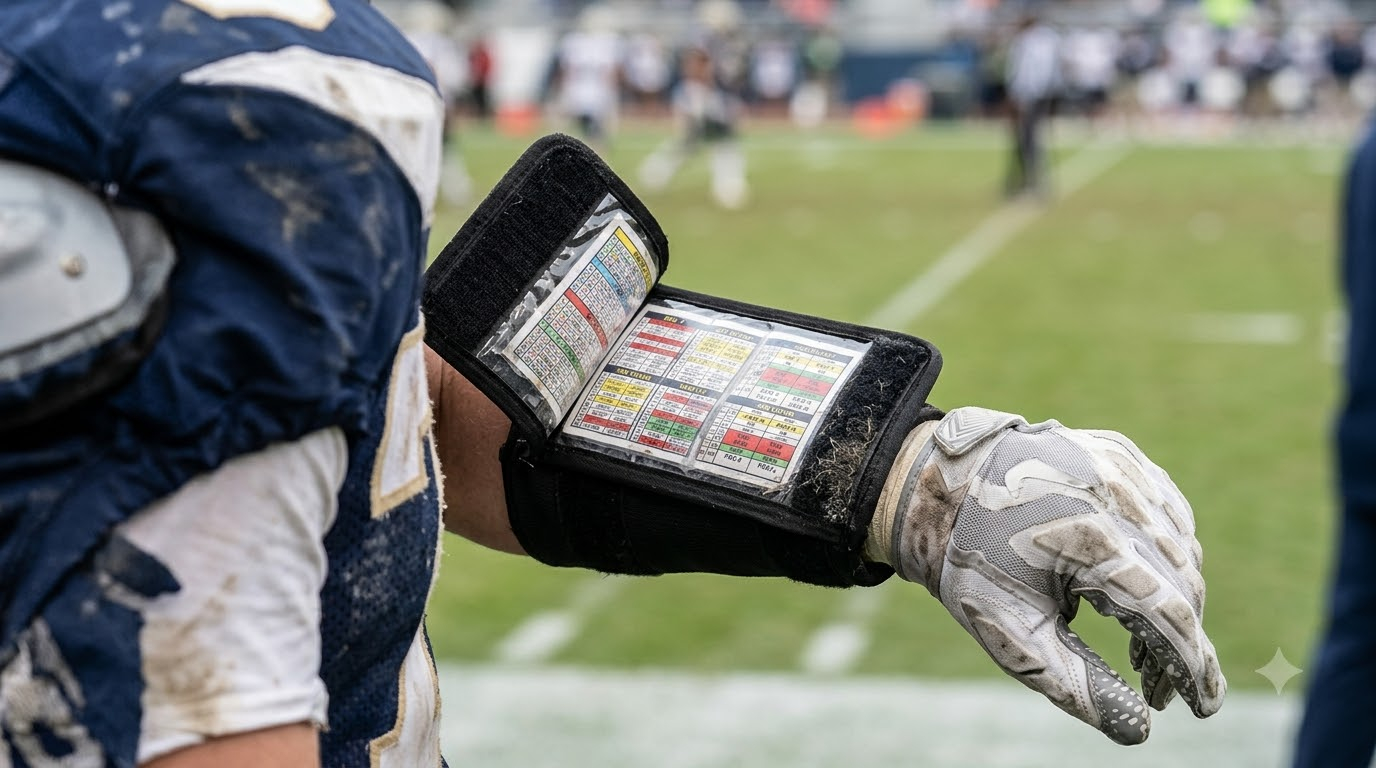

A quarterback may understand the entire offensive playbook during practice and still struggle to recall the right details when the game becomes fast and unpredictable. The challenge is not always learning more plays. It is finding the correct information quickly, remembering the order of responsibilities, and communicating the call clearly. A well-prepared qb playbook wristband for quick access to essential offensive information can help turn a complicated playbook into a compact reference that players can use during a game.
The key is to avoid treating the wristband as a miniature copy of the entire playbook. It should contain short prompts that help the quarterback recall plays already taught and rehearsed by the coaching staff. The full explanation belongs in meetings and practice; the wristband should make the important details easier to retrieve.
Why a full playbook does not belong on a wristband
A team playbook can contain formations, personnel groupings, route combinations, blocking assignments, protection rules, audibles, and situational calls. Those details are important, but placing all of them into a small display creates a new problem: the player has too much information to scan.
A useful wristband insert has a different purpose. It acts as a reference key. The quarterback sees a short code or label and recalls the complete play from practice.
For example, a wristband entry might show:
-
Formation abbreviation
-
Play number or short name
-
Primary concept
-
Protection reminder
-
A brief adjustment cue, if required
The exact terminology should match the team's existing language. Coaches should not introduce a second naming system simply because the information is being printed in a smaller format.
Start by identifying what the quarterback needs to remember
Before designing the insert, review the offensive system and identify the information that is most likely to be forgotten or confused. This step is more useful than immediately deciding how many plays to print.
Ask the coaching staff and quarterback:
-
Which calls are used most often?
-
Which plays have similar names or numbers?
-
Which formations require a reminder?
-
Which protection checks must be communicated?
-
Which situational calls need to be available without searching through a long list?
The answers will vary between teams. A youth team learning a small set of core plays will need a different reference from a high school or adult team using a larger offensive package.
The aim is to remove unnecessary reading while keeping the cues that matter.
Build the insert around recognition, not long explanations
A wristband entry should trigger recall. It should not require the quarterback to read a paragraph before the snap.
Consider the difference:
|
Too much information |
More useful prompt |
|
A full sentence describing every receiver's route |
Short route-concept label |
|
A paragraph explaining the blocking scheme |
Recognisable protection code |
|
Several lines describing when to use the play |
Short situation label |
|
A long explanation of the formation |
Team-approved formation abbreviation |
A short label is only useful when every player understands it. If a code is unfamiliar, it can slow communication instead of improving it. Introduce each abbreviation in a meeting, demonstrate it on the field, and test whether players can explain it without looking at the full playbook.
Create a consistent naming system before printing
One common mistake is changing play names between the playbook, practice script, wristband, and sideline communication. A play might be called one thing in a meeting and shortened differently on the insert. That creates uncertainty at the exact moment the quarterback needs clarity.
Use one naming convention across the team's materials.
A practical process is:
-
Choose the official play name. Use the term coaches already teach.
-
Create an approved short label. Remove extra words without changing the meaning.
-
Assign a unique identifier if needed. Avoid using similar numbers for plays that are easy to confuse.
-
Check formation and personnel references. Make sure the short entry still points to the correct setup.
-
Test the label aloud. The quarterback should be able to communicate it clearly.
A qb playbook wristband works best when the printed information and the language used by coaches are consistent. The player should not need to translate between two systems during a drive.
Separate core plays from situational information
Not every play deserves the same priority. If the insert is filled with rarely used calls, the quarterback may have to search through unnecessary entries to find a familiar option.
Organise the play list around how the team actually uses it. One possible approach is to identify:
-
Core offensive calls
-
Short-yardage situations
-
Red-zone options
-
Third-down concepts
-
Special situation or change-up calls
This is an organisational example, not a universal playbook structure. A team should use categories that match its offensive system and coaching terminology.
The purpose of the qb playbook wristband is to make the next relevant option easier to locate. Avoid adding categories simply to make the insert appear more comprehensive.
Use a controlled version process
A wristband can become unreliable when coaches update the playbook but forget to update the printed insert. A quarterback may then refer to an outdated call, an old play number, or a formation that has changed.
Treat each insert as a controlled team document.
A simple version-control routine:
-
Give each insert a version date or practice-week label.
-
Keep one master copy with the offensive coordinator.
-
Record every change to a play name, number, or assignment.
-
Remove old copies before distributing the updated version.
-
Confirm that the quarterback and relevant coaches have the same version.
Do not make last-minute changes without communicating them. If a play has been modified, the team must rehearse the updated assignment before relying on the new reference during a game.
Match the printed layout to the wristband window
A layout that looks clear on a computer screen may be difficult to read when reduced to a wristband insert. Use a readable type size, strong contrast, short labels, and consistent spacing.
TAG Sports Gear lists its five-window quarterback wristband in adult and youth versions. The product information gives an adult window size of 5 by 3 inches and a youth window size of 4 by 2.5 inches. It also specifies that adult play cards should be no larger than 4.75 by 2.5 inches. Check the current product instructions and measure the actual insert before printing.
For more information about the available football equipment and accessories, visit TAG Sports Gear.
Do not assume that the same insert will be equally readable in every size. A youth-sized window may require fewer words, shorter labels, or a different layout.
A practical workflow for preparing the wristband
Use the following workflow to move from a full playbook to a usable game-day insert.
Step 1: Select the plays. Start with the calls the team has learned and expects to use. Do not include unpractised plays just because space is available.
Step 2: Confirm the terminology. Ask the offensive coordinator to approve every abbreviation, number, and short name.
Step 3: Create a draft. Arrange the entries in a logical order. Keep related information together and avoid crowded blocks of text.
Step 4: Print a test copy. Use the correct dimensions for the adult or youth wristband. Check that the insert fits without folding or covering important text.
Step 5: Run a recognition test. Give the quarterback a call and ask them to find the matching entry. Note any hesitation or confusion.
Step 6: Rehearse communication. Practise receiving the call, locating the prompt, communicating the play, and setting the offense.
Step 7: Approve the final version. Make corrections before distributing the final insert to players and coaches.
Two examples of better playbook organisation
Example 1: A team with too many similar play names
A team has several plays with similar names. During practice, the quarterback occasionally selects the wrong entry because the labels are difficult to distinguish.
The coach reviews the naming system and gives each play a distinct, approved short label. The team then practises identifying the call from the sideline and repeating it accurately. The improvement comes from clearer terminology and repetition, not simply from printing a new wristband.
Example 2: A team that changes its weekly game plan
A team adds a small number of opponent-specific calls each week. The quarterback's insert gradually becomes cluttered because old entries are never removed.
The staff creates a weekly master list, removes calls that are no longer required, and checks every change against the current practice script. The insert becomes easier to scan because it reflects the current plan rather than every play the team has ever used.
Illustrative case study: Reducing confusion before the snap
The following is a hypothetical example, not a reported customer result.
A school team notices that its quarterback regularly asks coaches to repeat calls during practice. The coaching staff initially assumes that the player needs to memorise more plays. After reviewing practice, they discover that several calls use similar abbreviations and that the printed reference does not match the latest playbook.
The coaches simplify the labels, remove unused entries, and update the master insert. They then run short drills in which the quarterback must locate a call, communicate it, and set the formation. The staff reviews errors after each session and adjusts unclear labels.
The lesson is straightforward: a reference tool is only as effective as the system behind it. Better organisation, consistent terminology, and regular practice are all necessary.
Common mistakes to avoid
-
Printing the entire playbook: A small display is not the right place for long explanations.
-
Using unexplained abbreviations: Short labels must be familiar to the players.
-
Changing terminology too often: Keep the playbook, practice script, and insert aligned.
-
Ignoring insert dimensions: A card that is too large may not fit correctly.
-
Skipping practice tests: Players should rehearse using the actual printed reference.
-
Keeping outdated copies: Remove old versions when the game plan changes.
Conclusion
A quarterback needs to process information quickly, but a wristband cannot replace preparation or understanding of the offensive system. Its job is to make familiar information easier to retrieve when the pace of the game increases.
A carefully designed qb playbook wristband should use clear labels, consistent terminology, a controlled update process, and only the information the quarterback genuinely needs. When coaches test the insert during practice and keep it aligned with the current playbook, it can become a practical support for game-day communication.
Frequently asked questions
1. What should be included on a quarterback playbook wristband?
Include short play identifiers, formation references, concept labels, or other reminders that the quarterback has already learned. Avoid lengthy explanations that are difficult to read quickly.
2. Should every play in the offensive playbook be printed?
No. Select the calls that are relevant to the team's current game plan. A shorter, well-organised list is often easier to use than a crowded insert.
3. How often should a quarterback wristband insert be updated?
Update it whenever the team's approved play names, assignments, or weekly game plan changes. Keep a master version so coaches and players work from the same information.
4. Can youth players use a five-window quarterback wristband?
The listed TAG product has both adult and youth versions. The youth version has a smaller display window, so the insert should be designed to suit that size and the player's reading needs.
5. How can coaches check whether the insert is easy to use?
Run practice drills in which the quarterback receives a call, finds the entry, communicates it, and sets the offense. Record confusing labels and revise them before game day.

