

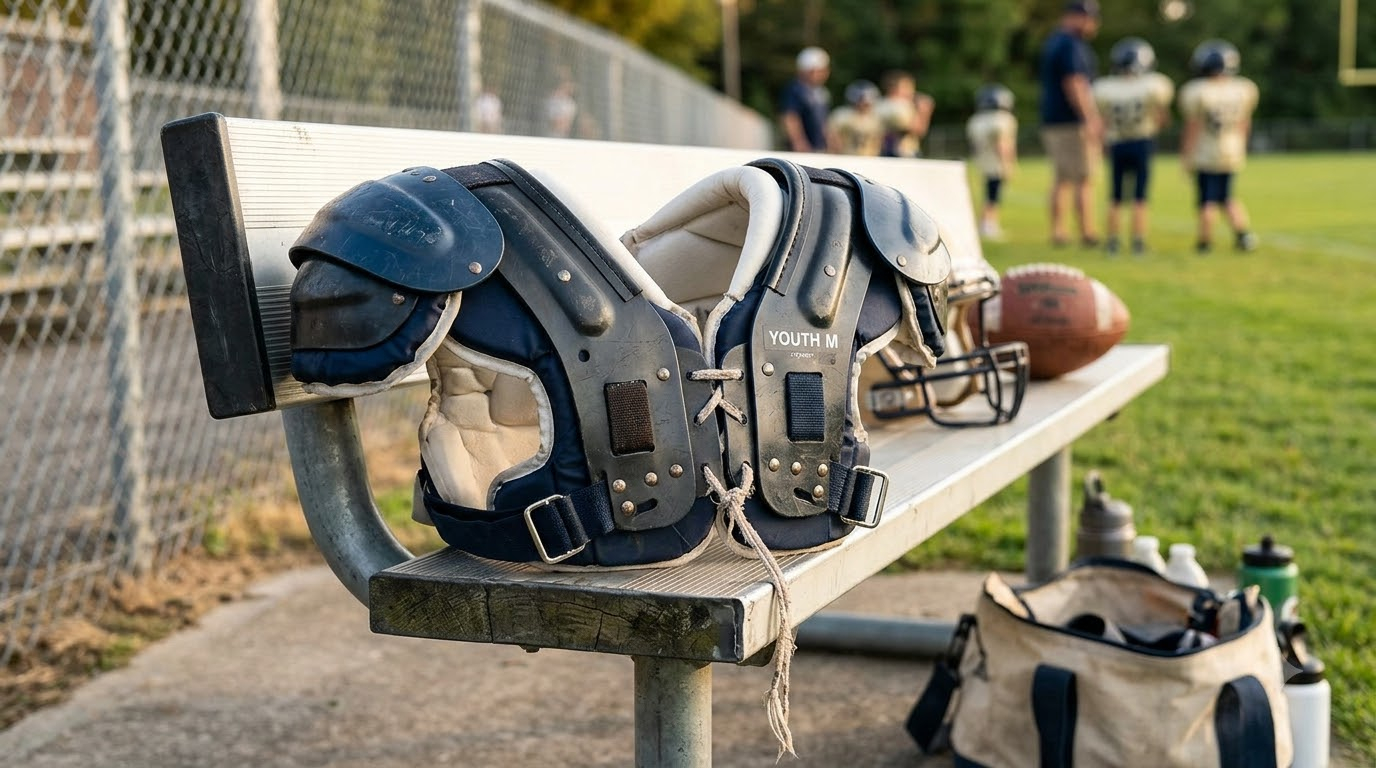

A new football season often means new schedules, new practice routines, and sometimes new equipment. For young players, one important task is checking whether last season's shoulder pads still fit. Children grow, equipment gets used, and straps or padding can wear down over time. Before buying or reusing youth football shoulder pads for the upcoming season, parents should review the player's current measurements, inspect the equipment, and make sure the complete setup follows the manufacturer's instructions.
A preseason check should not be limited to asking whether the pads still fasten. The equipment needs to sit correctly, remain in its intended position, and allow normal movement. A careful inspection can also help identify damaged components before the first practice.
Why last season's fit should not be taken for granted
Children can grow significantly between seasons. A shoulder pad that fitted properly several months ago may no longer be the right size. Even if the player can still put it on, the shoulder caps, straps, and closures may not sit as intended.
Parents should avoid using age, height, or an old clothing size as the only guide. Different models have different sizing systems, and the player's current measurements are more useful than assumptions based on the previous season.
The TAG ALT III 944 is listed as an all-position youth shoulder pad. Its product information provides shoulder-width and weight ranges for each listed size. Those measurements give parents a starting point for checking whether the model is appropriate.
Build a preseason equipment record
A simple equipment record makes it easier to track changes from one season to the next. It does not need to be complicated. Record the player's measurement, the equipment model, the size, and the date of the fitting.
A basic record can include:
|
Information to record |
Why it matters |
|
Shoulder measurement |
Helps compare the player's current size with the product chart |
|
Player's weight |
Can be checked against the manufacturer's listed range |
|
Product model |
Prevents confusion between different pad designs |
|
Size selected |
Makes future checks easier |
|
Fitting date |
Shows when the equipment was last reviewed |
|
Inspection notes |
Records damaged straps, worn lining, or fit concerns |
Keep the record with the player's equipment information. Update it when the player grows or when a new model is purchased.
Measure the player using the product's instructions
Sizing systems should not be treated as interchangeable. One brand may use shoulder width, while another may provide different measurement instructions.
For the TAG ALT III 944, the product guidance emphasises shoulder measurements rather than chest measurements because chest fit can be adjusted. Parents should therefore follow the manufacturer's instructions for measuring shoulder width.
A reliable measuring routine includes:
-
Read the measuring instructions for the exact model.
-
Use a flexible tape measure.
-
Position the tape as directed.
-
Record the measurement accurately.
-
Compare it with the product's size chart.
-
Check the listed weight range.
-
Ask the retailer or manufacturer for guidance if the results are unclear.
Do not force the player into a size because it is the one they wore last year. The purpose of measuring is to check the current fit, not to confirm an old purchase.
Understand the ALT III 944 size ranges
The TAG product listing provides the following size information:
|
Size |
Shoulder width |
Weight range |
|
XXS |
10–11 in |
20–40 lb |
|
XS |
11–12 in |
40–60 lb |
|
S |
12–13 in |
60–80 lb |
|
M |
13–14 in |
80–100 lb |
|
L |
14–15 in |
100–120 lb |
|
XL |
15–16 in |
120–150 lb |
|
2XL |
16–17 in |
150–180 lb |
This is the chart for the listed model, not a universal chart for all brands. If the player's shoulder measurement and weight range appear to indicate different sizes, seek product-specific advice rather than guessing.
Inspect more than the outside shell
A visual check should include the components that help the shoulder pads sit and remain secured.
For the ALT III 944, the product description lists high-density foam, removable deltoid pads, an adjustable swivel front-and-back closure system, stainless steel hardware, and a COOLMAX mesh lining.
During inspection, look at:
-
The condition of the padding
-
The attachment points around removable components
-
The straps and closures
-
The buckle and hardware
-
The lining and fabric
-
Any visible cracks, tears, or loose stitching
Do not use damaged equipment without first getting advice from the manufacturer, retailer, or qualified equipment staff. Do not attempt repairs or alterations that are not authorised by the manufacturer.
Complete a movement check
A pad fitting is not complete simply because the player can put the equipment on. The player should be able to move naturally while the shoulder pads remain in the intended position.
Ask the player to perform appropriate non-contact movements:
-
Raise both arms.
-
Lower both arms.
-
Rotate the upper body.
-
Bend and straighten.
-
Move through the team's normal warm-up positions.
Observe whether the shoulder pads shift, tilt, or create obvious restrictions. Ask the player where they feel pressure or discomfort. If something does not seem right, stop and review the fit rather than tightening the equipment excessively.
A movement check does not certify that the equipment is protective or suitable for contact. It is one part of a proper fitting process.
Make the fitting part of the team's preseason routine
Coaches and equipment managers can help parents avoid rushed decisions by scheduling equipment checks before contact practices begin.
A useful team process is to:
-
Tell families which equipment models and standards are required.
-
Share the manufacturer's measurement instructions.
-
Arrange a fitting opportunity.
-
Check the equipment's condition.
-
Review closures and adjustment points.
-
Confirm that players understand how to put on and remove their equipment.
-
Ask families to report growth or fit concerns during the season.
For families comparing football equipment, TAG Sports Gear provides product information that can help them review model features and sizing details.
Two examples of preseason checks
Example 1: The pads still fasten, but the player has grown
A young player returns for a new season wearing the same shoulder pads as the previous year. The straps close, so the parent initially assumes the equipment still fits.
During the preseason check, the parent takes a new shoulder measurement and compares it with the product chart. The result suggests that the old size should not be assumed to remain suitable. The family arranges a fresh fitting before the player joins contact practice.
Example 2: A damaged closure is found during inspection
A parent notices that one closure looks worn. The shoulder pads can still be put on, but the fastening component does not appear to be in the same condition as the other side.
Instead of attempting an improvised repair, the parent contacts the retailer for guidance. The equipment is checked before use. The lesson is that a fit check and a condition check should always be carried out together.
Illustrative case study: A team introduces a preseason fitting day
This is a hypothetical example, not a reported customer result.
A youth football team has noticed that several players arrive at the first practice with equipment they have not worn since the previous season. Some players have grown, and a few sets of pads show worn straps or damaged lining.
The coach introduces a preseason fitting day. Families bring the equipment, record current shoulder measurements, and compare them with the relevant product charts. The equipment manager checks visible wear and asks players to perform simple movement checks. Any unclear fit or damage is referred for further guidance before contact practice.
The process helps the team identify concerns earlier instead of discovering them during a rushed first session.
Care and storage between practices
Shoulder pads should be cared for according to the manufacturer's directions. The TAG listing describes the ALT III 944 as machine washable, but parents should still follow the current care instructions supplied with the product.
After practice, inspect the equipment and allow it to dry as directed. Store it in a suitable place rather than leaving it damp in a closed bag for an extended period.
Check the following throughout the season:
-
Straps and closures
-
Buckles and hardware
-
Padding and attachment points
-
Lining and fabric
-
Changes in fit as the player grows
If a component becomes damaged or the equipment no longer fits correctly, seek manufacturer or retailer advice before the next use.
Common preseason mistakes
-
Assuming last season's size will still fit
-
Choosing by age instead of current measurements
-
Using a different model's sizing chart
-
Checking only whether the straps can fasten
-
Ignoring worn hardware or damaged padding
-
Making unauthorised changes to the equipment
-
Waiting until the first contact practice to inspect the pads
Conclusion
Preparing youth football shoulder pads for a new season requires more than taking them out of storage. Parents should check the player's current shoulder measurement, compare it with the correct product chart, inspect the equipment, and review the fit during normal movement.
The TAG ALT III 944 listing provides model-specific sizing information and describes features such as high-density foam, removable deltoid pads, and an adjustable closure system. Use those details as a guide, but always follow the manufacturer's fitting and care instructions. A preseason check helps families identify fit and condition concerns before the player returns to practice.
Frequently asked questions
1. Should young players use the same shoulder pads every season?
Only if the equipment remains in suitable condition and still fits according to the manufacturer's instructions. Recheck measurements as the player grows.
2. What measurement matters when choosing the ALT III 944?
The product guidance emphasises shoulder measurements rather than chest measurements. Follow the manufacturer's measuring instructions and review the listed weight range as well.
3. How can parents tell if shoulder pads need replacing?
Look for damaged padding, worn closures, loose stitching, damaged hardware, or a fit that can no longer be adjusted correctly. Seek manufacturer or retailer advice if unsure.
4. Can parents adjust shoulder pads at home?
Follow the manufacturer's instructions for permitted adjustments. Do not modify or remove components unless the manufacturer specifically allows it.
5. When should a preseason fitting take place?
Complete it before contact practice begins. This gives the family time to address sizing or equipment-condition concerns without rushing.

