

Automotive Simulation Software Market Outlook Shows Promising Opportunities Through Advanced Digital Engineering Innovation

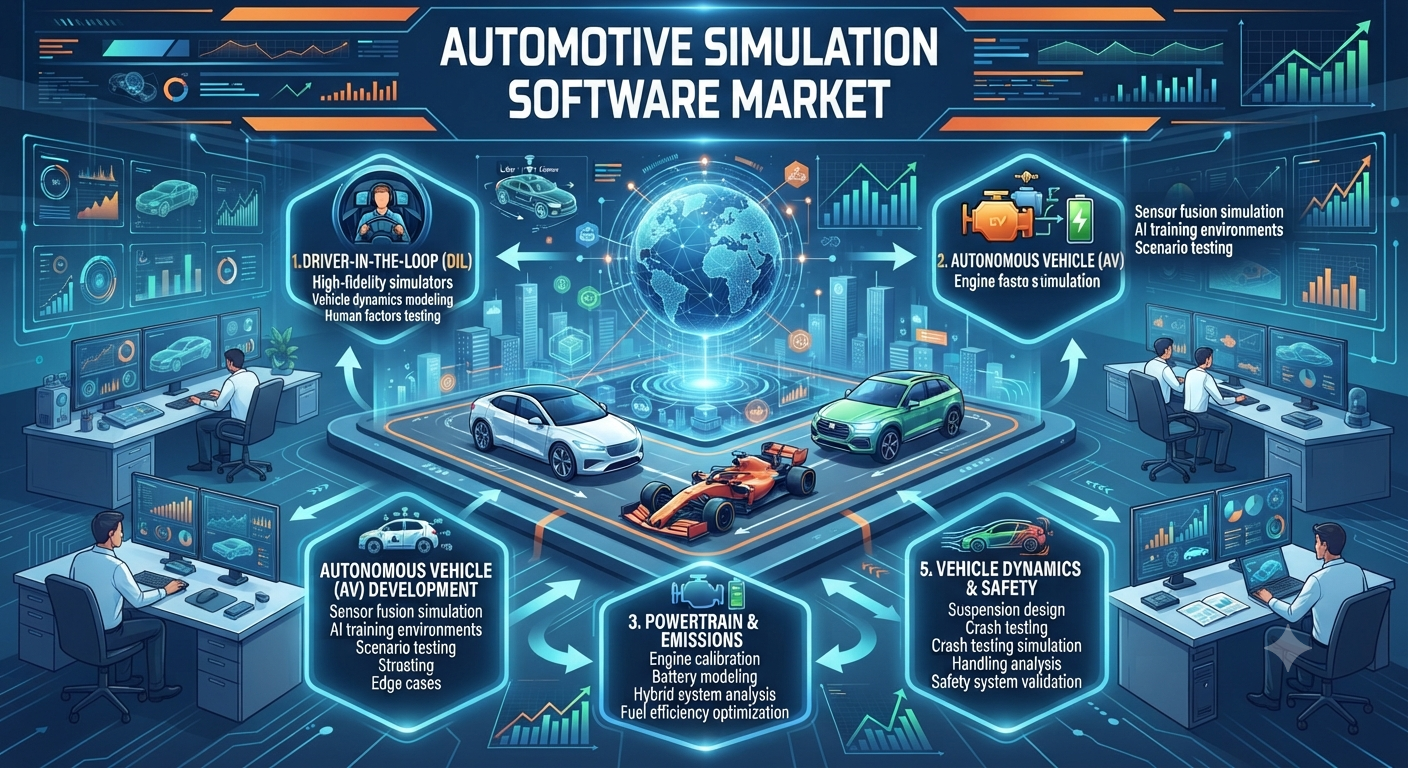
The Automotive Simulation Software Market Outlook indicates a promising development trajectory as automotive manufacturers increasingly depend on virtual engineering and advanced testing technologies. Simulation software is becoming essential for evaluating vehicle performance, improving passenger safety, and accelerating product development. The industry is projected to increase from USD 6.44 billion in 2025 to USD 21.09 billion by 2035, reflecting a CAGR of 12.6% during the forecast period of 2026–2035. This anticipated expansion is supported by electric vehicle development, autonomous mobility investments, software-defined vehicle architectures, and increasing requirements for vehicle safety validation. Manufacturers are gradually replacing certain conventional testing activities with sophisticated virtual simulation workflows. These systems enable engineering teams to investigate different design alternatives without repeatedly constructing expensive physical prototypes. As automotive technologies become more sophisticated, simulation platforms will play a greater role in improving engineering productivity and supporting innovation across the global automotive industry.
Paragraph 2: Artificial Intelligence Transforming Simulation
Artificial intelligence is expected to influence the future development of automotive simulation platforms. AI-powered technologies can assist engineers with model preparation, simulation automation, design optimization, and identification of unusual performance patterns. Machine learning techniques can also support faster calculations by creating predictive models based on previously generated simulation data. This approach may reduce the time required for certain engineering investigations. Generative technologies can help create additional virtual driving scenarios for testing autonomous vehicle systems. These capabilities are particularly valuable when engineers need to evaluate unusual road conditions or complex interactions between vehicles, pedestrians, and infrastructure. However, AI-assisted results must be validated carefully to ensure engineering reliability. Combining established physics-based simulation with machine learning is likely to become an important technological direction for software providers.
Paragraph 3: Electric Mobility and Autonomous Vehicle Development
The expansion of electric mobility will continue creating demand for advanced simulation technologies. Automotive manufacturers must evaluate battery durability, charging performance, thermal behaviour, vehicle weight distribution, and powertrain efficiency. Simulation software enables companies to examine these factors during early design stages. Autonomous vehicle development will also require extensive virtual validation because self-driving technologies must respond appropriately to numerous traffic scenarios. Sensor simulation, environmental modelling, and virtual road testing will remain important areas of development. Advanced driver assistance systems require continuous evaluation to improve reliability under changing road conditions. Manufacturers are therefore likely to increase investments in simulation environments that combine vehicle models, electronic systems, sensors, and software applications. This growing technological integration will create additional opportunities for specialized software developers.
Paragraph 4: Cloud Adoption and Regional Opportunities
Cloud-based simulation is expected to become increasingly important because automotive engineering requires substantial computing capacity. Cloud deployment allows companies to access scalable processing resources and conduct complex simulations without purchasing all computing infrastructure internally. Collaborative platforms can also support engineering teams working across multiple countries and development centres. Asia-Pacific is expected to remain an important growth region because of automotive production, electric vehicle investment, and expanding engineering service capabilities. India presents opportunities through its growing automotive technology ecosystem and engineering workforce. China continues to influence regional demand through electric vehicle development and connected mobility programmes. North America and Europe will maintain strong positions through advanced research, software innovation, and regulatory testing requirements. These regional developments will create opportunities for established vendors and emerging simulation technology providers.
Paragraph 5: Long-Term Market Prospects
The long-term outlook for automotive simulation software remains positive as manufacturers move toward more digital and connected vehicle development processes. Digital twins, AI-assisted engineering, cloud high-performance computing, and automated validation will influence future software capabilities. Simulation providers may increasingly offer integrated subscriptions, specialized engineering services, and scenario-based testing solutions. Nevertheless, high licensing costs, limited technical expertise, data protection requirements, and integration difficulties could restrict adoption among smaller businesses. Vendors that address these challenges through flexible deployment options and simplified engineering workflows may strengthen their market positions. As automotive companies seek to reduce development time while improving vehicle performance and safety, virtual engineering will become an increasingly important competitive advantage. The industry is therefore expected to benefit from sustained technological innovation throughout the forecast period.
➤ Exclusive Research Publications by Market Research Future:

