

Cold Insulation Industry Report: Key Players and Competitive Landscape Through 2035

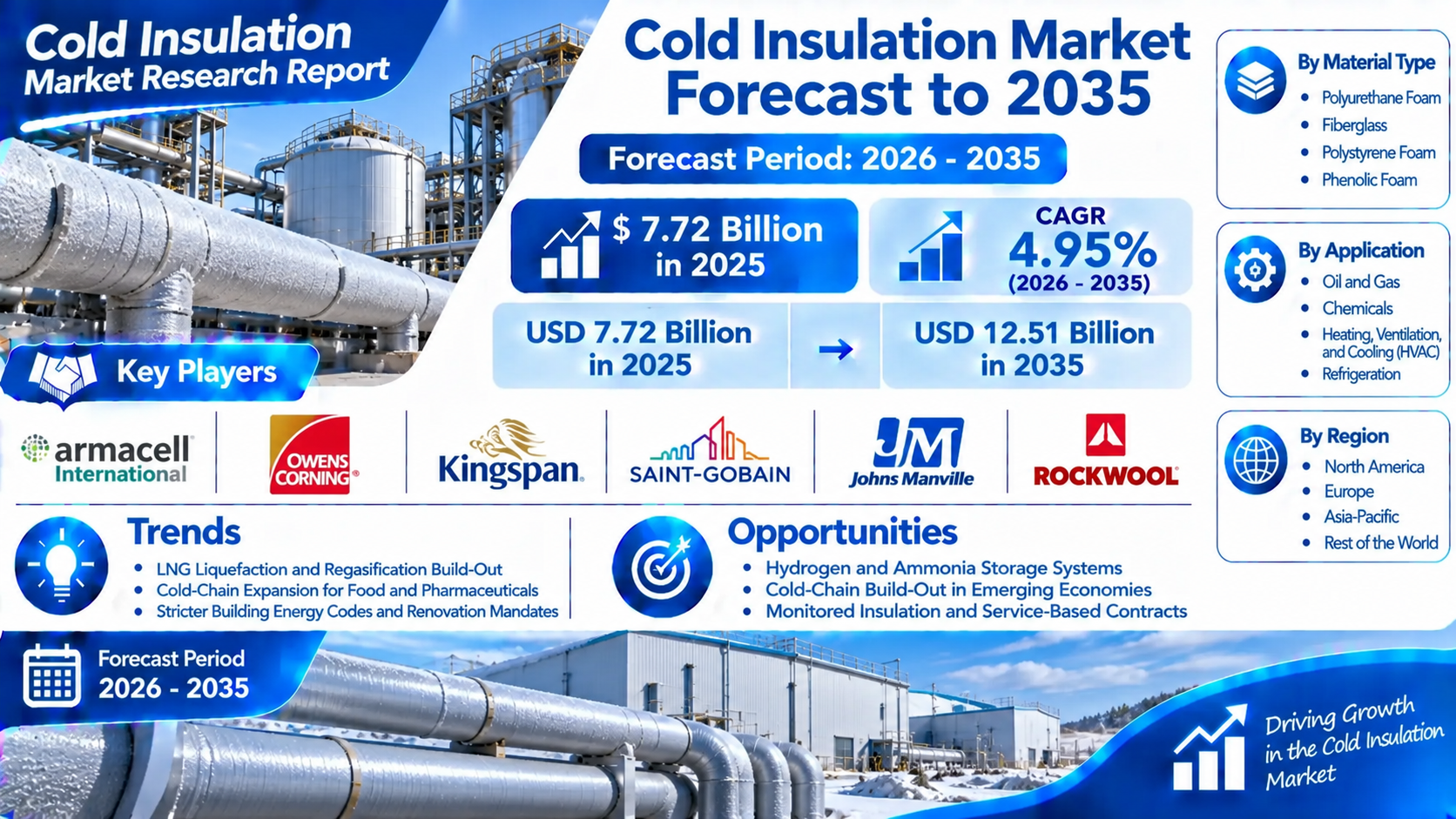
According to Market Research Future® (MRFR), the Global Cold Insulation Market is expected to expand from USD 7.72 billion in 2025 to USD 12.51 billion by 2035, reflecting a CAGR of 4.95% during the 2026–2035 forecast period. The market serves industries and infrastructure that depend on maintaining controlled low-temperature conditions, including oil and gas, chemicals, HVAC, and refrigeration. Investment in LNG facilities, the development of cold-chain networks, and evolving building energy requirements are creating important areas of activity for insulation suppliers.
Market Expansion and Industry Context
Cold insulation is relevant wherever industrial processes, storage facilities, or building systems require controlled thermal conditions at low temperatures. Its role across energy infrastructure, chemical operations, and refrigeration makes it an important part of several industrial value chains.
The market was valued at USD 7.72 billion in 2025 and is projected to reach USD 12.51 billion by 2035. The expected CAGR of 4.95% applies to the forecast period from 2026 to 2035. This growth outlook reflects demand across multiple applications rather than reliance on a single end-use industry.
The development of LNG infrastructure is one of the important factors shaping the market. Liquefaction and regasification facilities require insulation solutions suited to their low-temperature operating environments. Beyond energy infrastructure, cold-chain investment and building energy requirements are expanding the range of areas in which cold insulation is relevant.
Four Material Groups Define the Market
The report classifies cold insulation materials into polyurethane foam, fiberglass, polystyrene foam, and phenolic foam. These four categories provide the product framework for the global market.
Polyurethane foam and polystyrene foam are two of the specified material groups, while fiberglass and phenolic foam complete the segmentation. Their inclusion reflects the range of insulation materials used across different applications. Project requirements and operating conditions influence the choice of material, making the product landscape an important part of market analysis.
The range of materials also creates a competitive environment in which suppliers serve different industrial requirements. Oil and gas infrastructure, chemical facilities, HVAC installations, and refrigeration systems each represent application areas within the report's scope. The market's material categories provide the basis for understanding the products available to these industries.
Oil and Gas and Chemical Applications
Oil and gas is one of the market's key application segments. LNG liquefaction and regasification build-out is identified as a major trend, linking insulation demand with the development of energy infrastructure. As these facilities are developed, low-temperature operating requirements make cold insulation an important consideration.
Chemical applications represent another part of the market. Industrial chemical operations can involve temperature-controlled environments, supporting the need for appropriate insulation systems. The report identifies chemicals as a distinct application category, highlighting the market's connection with industrial processing.
These applications demonstrate the importance of cold insulation beyond conventional building systems. Energy and chemical infrastructure provide a separate demand environment, shaped by industrial facilities and their operating requirements.
HVAC and Refrigeration Extend Market Demand
Heating, ventilation, and cooling (HVAC) is another application category. Building energy performance is an increasingly relevant consideration, particularly as stricter building energy codes and renovation mandates influence industry practices. These developments are encouraging attention to thermal performance and the role of insulation within building systems.
Refrigeration is also an important application area. The expansion of cold-chain networks for food and pharmaceuticals is identified as a major market trend. Temperature-controlled storage and related infrastructure depend on suitable systems for maintaining required conditions, creating demand opportunities for cold insulation.
The connection between refrigeration and cold-chain development is particularly significant because it links insulation requirements with the movement and storage of temperature-sensitive products. As cold-chain infrastructure expands, insulation solutions can become relevant across a wider network of facilities.
Regional Scope and Emerging Economy Potential
The report divides the global market into North America, Europe, Asia-Pacific, and the Rest of the World. These regions provide the geographical framework for evaluating the industry's overall development.
Demand conditions across regions are influenced by industrial activity, energy infrastructure, building requirements, and investment in temperature-controlled logistics. The report specifically identifies cold-chain build-out in emerging economies as an opportunity, suggesting that developing storage and distribution infrastructure may create additional demand for insulation products.
The regional segmentation also reflects the global reach of the market. However, the supplied market information does not provide individual regional valuations, shares, or growth rates. The forecast of USD 12.51 billion by 2035 therefore represents the global market outlook rather than a projection for any one region.
New Opportunities in Hydrogen and Ammonia Storage
Hydrogen and ammonia storage systems are identified as an emerging opportunity for the cold insulation industry. These applications may require insulation solutions suited to low-temperature storage conditions. As infrastructure connected with these energy carriers develops, the need for suitable insulation systems could create additional business opportunities.
This opportunity adds to the market's established connection with LNG infrastructure. While LNG liquefaction and regasification build-out is an identified trend, hydrogen and ammonia storage systems represent a separate area of potential development.
Monitored insulation and service-based contracts are another opportunity. These approaches can broaden the scope of industry participation beyond material supply by including monitoring and service arrangements. They may provide customers with additional support in managing insulation systems over time.
Industry Trends: Regulation and Energy Efficiency
Stricter building energy codes and renovation mandates are shaping the market's building-related environment. As energy performance becomes a more prominent consideration, insulation solutions remain relevant to renovation and building system decisions.
The trend complements technological developments and the market's broader focus on maintaining suitable thermal conditions. Cold insulation suppliers operate across applications with different technical and operational requirements, making the ability to address varied customer needs important.
Cold-chain expansion is also reinforcing the market's connection with food and pharmaceutical supply networks. Together, infrastructure development, building requirements, and changing storage needs create a varied set of demand influences.
Competitive Landscape
Armacell International, Owens Corning, Kingspan Group, Saint-Gobain, Johns Manville, and Rockwool are identified as key players in the Global Cold Insulation Market.
The competitive landscape includes companies serving a market that spans several material types and application areas. Participants are positioned within an industry influenced by LNG infrastructure, chemical operations, HVAC requirements, refrigeration, and emerging storage opportunities. The report identifies these companies as key players but does not provide company-level market shares or a competitive ranking.
Global Cold Insulation Market Forecast to 2035
The market's projected growth from USD 7.72 billion in 2025 to USD 12.51 billion in 2035, at a CAGR of 4.95% during 2026–2035, reflects the continuing role of insulation across industrial and infrastructure applications.
Polyurethane foam, fiberglass, polystyrene foam, and phenolic foam form the material segmentation, while oil and gas, chemicals, HVAC, and refrigeration define the application landscape. LNG infrastructure development, cold-chain expansion, and building energy requirements are major trends. Hydrogen and ammonia storage, emerging economy infrastructure, and monitored service contracts offer additional opportunities as the global industry advances through 2035.

