

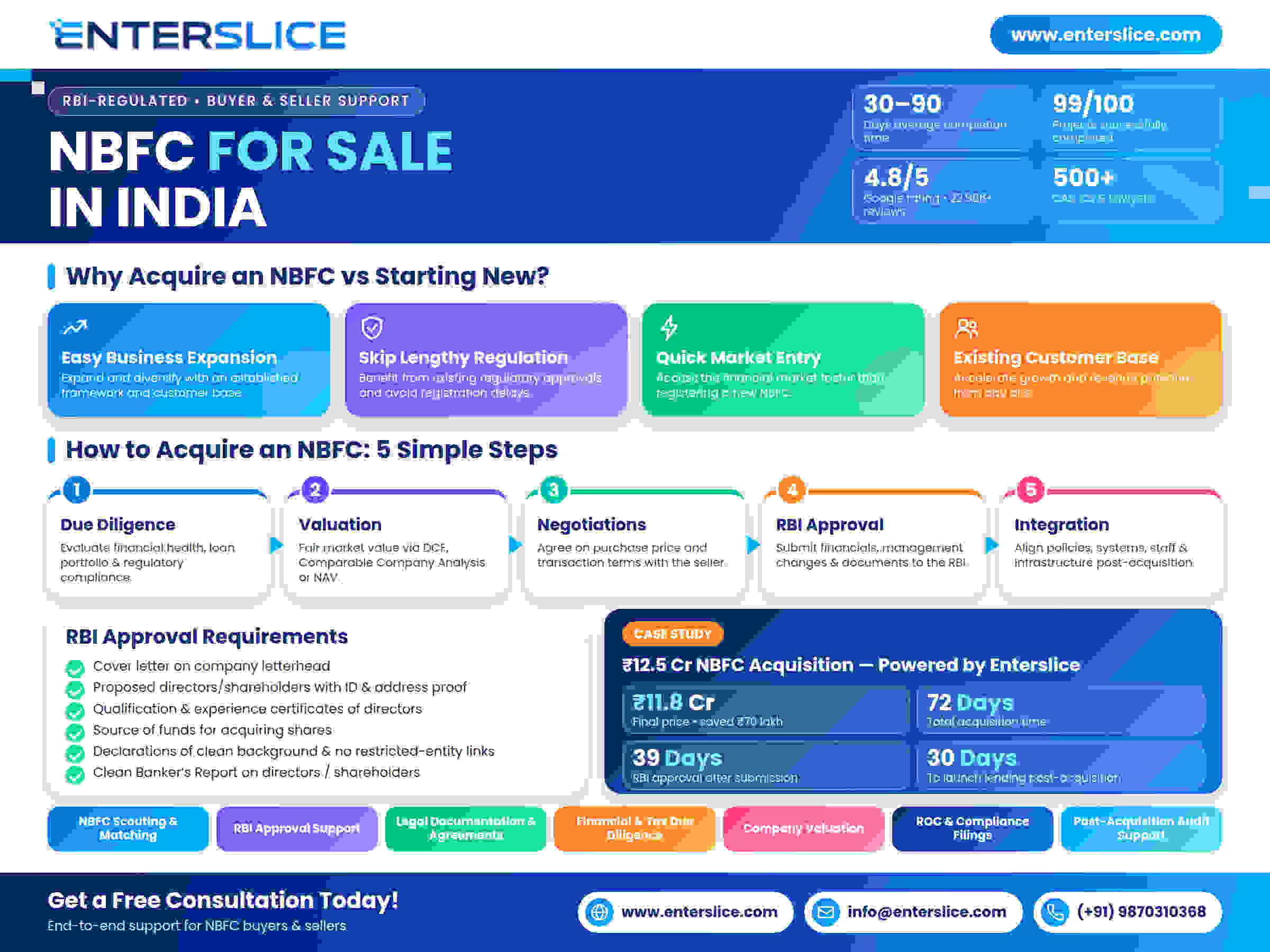
Old NBFC for Sale in India: Process, RBI Approval and Key Considerations Before Buying

Starting a Non-Banking Financial Company (NBFC) in India involves regulatory formalities, capital requirements, documentation and compliance obligations. For entrepreneurs and businesses planning to enter the financial services sector, acquiring an existing NBFC can be an alternative to establishing a new company and applying for registration.
The demand for an old NBFC for sale generally comes from investors, financial institutions, business groups and entrepreneurs who want to acquire an existing NBFC company with a history of incorporation and an existing RBI Certificate of Registration (CoR).
However, purchasing an old NBFC is not simply a matter of paying the seller and transferring the company's shares. The transaction requires careful legal and financial due diligence, an assessment of regulatory compliance and, where applicable, prior approval from the Reserve Bank of India (RBI).
Understanding these requirements before entering into an acquisition agreement can help buyers avoid unexpected liabilities and make an informed investment decision.
What Is an Old NBFC for Sale?
An old NBFC for sale refers to an already incorporated company that holds, or is represented as holding, an RBI Certificate of Registration to operate as a Non-Banking Financial Company.
Such companies may have been incorporated several years ago and may have an operating history, an existing business structure or a particular NBFC classification.
Depending on the company's circumstances, an acquisition may involve:
-
An existing NBFC with an active RBI Certificate of Registration.
-
A non-operational NBFC that continues to hold a valid registration.
-
An NBFC with an existing loan portfolio and business operations.
-
An NBFC with no substantial business activity but an existing corporate history.
-
An NBFC whose shareholders are looking to exit the business.
Buyers should distinguish between an NBFC company that merely has an old incorporation date and one that holds a valid RBI registration. An old company registration does not automatically provide permission to conduct NBFC business.
Why Are Entrepreneurs Looking for an Existing NBFC for Sale?
Acquiring an existing NBFC may offer certain strategic advantages over setting up a new company. However, the benefits depend on the company's regulatory status, financial position and business history.
1. Existing Corporate Structure
An existing NBFC already has a corporate identity, incorporation records, statutory documents and a management structure. This may reduce some initial company-formation work associated with starting a new business.
2. Existing RBI Registration
A company with a valid RBI Certificate of Registration may offer an established regulatory starting point. However, the buyer cannot assume that the registration can be transferred independently or used without following the applicable RBI approval process.
3. Faster Business Planning
An acquisition may allow investors to focus on business planning, operational development and financial products rather than beginning every corporate process from scratch.
The actual timeline will depend on regulatory approvals, due diligence, transaction complexity and the condition of the target company.
4. Established Business Records
Some existing NBFCs may have financial statements, banking relationships, operational records and a previous lending history. These records can help buyers assess the company's financial position and business potential.
5. Strategic Business Expansion
Companies already operating in financial services may consider acquiring an existing NBFC to expand their lending activities or enter a new segment, subject to the applicable regulatory framework.
Important RBI Regulations for Buying an Old NBFC
RBI approval is one of the most important considerations when purchasing an existing NBFC in India.
Under the Reserve Bank of India (Non-Banking Financial Companies – Acquisition of Shareholding or Control) Directions, 2025, an NBFC must obtain prior written permission from RBI for specified changes involving ownership and control.
Prior RBI permission is required in the following circumstances:
-
Any takeover or acquisition of control of an NBFC, whether or not it results in a change of management.
-
Any change in shareholding, including progressive increases over time, resulting in the acquisition or transfer of 26% or more of the paid-up equity capital.
The Directions also prescribe an exception relating to shareholding increases resulting from a buyback or capital reduction approved by a competent court.
Prior Public Notice Requirement
Under the 2025 Directions, a public notice must be issued at least 30 days before the transfer of ownership through a share sale or transfer of control.
The notice must be published in:
-
At least one leading national newspaper.
-
At least one leading local vernacular newspaper covering the location of the registered office.
The notice is to be issued after obtaining prior RBI permission. It must mention the proposed transaction, details of the transferee and the reasons for the ownership or control transfer.
Therefore, buyers should not complete an NBFC takeover merely on the basis of a private agreement with the existing shareholders.
Process to Buy an Old NBFC in India
Acquiring an existing NBFC involves several stages. A structured approach helps buyers identify regulatory concerns before committing substantial funds.
Step 1: Identify a Suitable NBFC
The first step is to identify an NBFC that matches the buyer's business objectives.
Consider the following factors:
-
Type and classification of the NBFC.
-
Date of incorporation.
-
RBI registration status.
-
Registered office and corporate records.
-
Existing business activities.
-
Financial and compliance history.
-
Shareholding and management structure.
The buyer should also clarify whether the company is operational or non-operational.
Step 2: Verify the RBI Certificate of Registration
The RBI Certificate of Registration is a critical document in an NBFC acquisition.
Buyers should verify the company's registration details and confirm whether the CoR is valid and whether any regulatory restrictions, cancellation proceedings or other adverse actions exist.
An old incorporation certificate or a seller's representation is not sufficient evidence of valid NBFC registration.
Step 3: Conduct Legal and Financial Due Diligence
Before proceeding with the purchase, conduct a detailed review of the target company's records.
This should cover:
-
Audited financial statements and annual returns.
-
Existing loans, borrowings and liabilities.
-
Tax filings and pending tax demands.
-
Litigation and regulatory notices.
-
Shareholding pattern and ownership records.
-
Statutory filings with the Ministry of Corporate Affairs.
-
RBI correspondence and regulatory compliance records.
-
Bank accounts and outstanding obligations.
The purpose is to identify financial exposure, undisclosed liabilities and regulatory concerns that could affect the acquisition.
Step 4: Negotiate the Acquisition Terms
After completing the initial assessment, the buyer and seller can negotiate the proposed transaction.
The agreement should clearly address the purchase consideration, payment arrangements, conditions precedent, seller warranties, indemnification, disclosure of liabilities and responsibilities of both parties.
The agreement should also make the required regulatory approval a condition for completing the transaction wherever applicable.
Step 5: Apply for Prior RBI Approval
Where the proposed acquisition falls within the approval requirements, the NBFC must submit an application to RBI through the PRAVAAH portal.
Under the 2025 Directions, the application should be submitted on the company's letterhead along with prescribed information and supporting documents, including:
-
Information about proposed shareholders.
-
Details of the sources of funds used to acquire the shares.
-
Required declarations from proposed shareholders.
-
Declaration regarding criminal cases, including offences under Section 138 of the Negotiable Instruments Act, 1881.
-
Bankers' reports on the proposed shareholders.
The exact documentation should be checked against the applicable RBI requirements and the relevant PRAVAAH process.
Step 6: Publish the Required Public Notice
After obtaining prior RBI permission, the parties must comply with the applicable 30-day public notice requirement before effecting the transfer of ownership or control.
The notice should contain the particulars prescribed under the RBI Directions.
Step 7: Complete the Transaction and Post-Acquisition Compliance
Once the applicable approvals and transaction conditions have been satisfied, the parties can complete the acquisition and undertake the required corporate and regulatory filings.
The new management should also review ongoing obligations relating to financial reporting, statutory audits, RBI returns, governance, risk management and other applicable NBFC regulations.
Documents Required for Purchasing an Existing NBFC
The documentation will depend on the structure of the transaction and the regulatory status of the target company.
|
Document category |
Important documents |
|
Corporate records |
Certificate of Incorporation, MOA and AOA |
|
RBI records |
Certificate of Registration and RBI correspondence |
|
Financial records |
Audited financial statements and annual reports |
|
Ownership records |
Shareholding pattern and share transfer records |
|
Tax documents |
Income tax returns and GST records, where applicable |
|
Compliance records |
Statutory filings and regulatory returns |
|
Legal records |
Litigation details and pending notices |
|
Buyer documents |
KYC, source of funds and prescribed declarations |
|
Banking records |
Bank statements and bankers' reports |
A document checklist should be prepared before signing the final acquisition agreement.
Due Diligence Checklist Before Buying an Old NBFC
One of the biggest mistakes buyers make is evaluating an NBFC only on the basis of its registration status and quoted purchase price.
A valid CoR does not automatically mean that the company is financially sound or free from regulatory problems.
Consider the following checks before proceeding:
-
RBI registration: Verify the authenticity and current status of the Certificate of Registration.
-
Regulatory history: Review RBI notices, inspection observations, restrictions and pending proceedings.
-
Financial position: Examine audited accounts, outstanding liabilities and contingent obligations.
-
Litigation: Identify pending civil, criminal, tax and regulatory cases.
-
Shareholding: Verify the ownership structure and any existing pledges or disputes involving shares.
-
Statutory compliance: Review MCA filings, tax compliance and applicable regulatory returns.
-
Business operations: Examine the loan portfolio, recovery position and outstanding customer obligations, where relevant.
-
Management: Assess the proposed directors and shareholders against applicable fit-and-proper requirements.
Buyers should also investigate whether the NBFC has accepted public deposits and whether it has outstanding obligations towards depositors or other creditors.
What Determines the Cost of an Old NBFC for Sale?
There is no standard purchase price for an existing NBFC in India. The valuation depends on several commercial and regulatory factors.
Some important considerations include:
-
Age and corporate history of the company.
-
Validity and classification of RBI registration.
-
Existing business operations and loan portfolio.
-
Net worth and financial position.
-
Outstanding borrowings and liabilities.
-
Regulatory compliance history.
-
Pending litigation or disputes.
-
Marketability and commercial value of the business.
An NBFC with a clean regulatory record and an established operating business may have a different valuation from a non-operational company with limited assets.
Buyers should avoid relying solely on the seller's quoted price. An independent financial and legal assessment can help determine whether the proposed consideration is commercially reasonable.
Common Risks Associated with Buying an Old NBFC
Although an acquisition may offer strategic advantages, it also carries certain risks.
Hidden liabilities: The company may have unpaid taxes, undisclosed borrowings, pending litigation or creditor claims.
Regulatory non-compliance: Earlier management may have failed to submit required returns or comply with applicable RBI directions.
Invalid registration claims: A seller may advertise an NBFC as registered without adequately disclosing its current regulatory status.
Shareholding disputes: Existing pledges, ownership disagreements or incomplete share transfer records may delay the transaction.
Business restrictions: The target company may have regulatory restrictions or other limitations affecting its proposed business activities.
A comprehensive due diligence exercise, appropriate contractual protections and regulatory review can help reduce these risks.
How Enterslice Can Help with NBFC Acquisition
Acquiring an existing NBFC requires coordination between corporate, financial and regulatory aspects. Enterslice assists businesses and investors in understanding the acquisition requirements and navigating the relevant compliance process.
Its support can include:
-
Identifying suitable acquisition opportunities.
-
Reviewing corporate and regulatory documentation.
-
Conducting legal and financial due diligence.
-
Assisting with the RBI approval process.
-
Supporting ownership and management change formalities.
-
Advising on post-acquisition compliance requirements.
The scope of assistance depends on the transaction structure and the specific requirements of the target NBFC.
Conclusion
Finding an old NBFC for sale can be a practical option for entrepreneurs and businesses looking to enter India's financial services sector through an acquisition. However, the age of the company or the existence of an RBI registration should never be the only basis for making a purchase decision.
Buyers must verify the registration status, examine the company's financial and legal history, understand the RBI approval requirements and complete the transaction through the appropriate legal process.
With proper due diligence and professional guidance, businesses can evaluate acquisition opportunities more effectively and reduce the risk of unexpected regulatory or financial complications.
If you are planning to purchase an existing NBFC, Enterslice can assist with the due diligence, regulatory assessment and acquisition-related compliance requirements.
Most popular services :

