

HDPE Resin Market Size, Segmentation, Competitive Landscape, and Regional Forecast

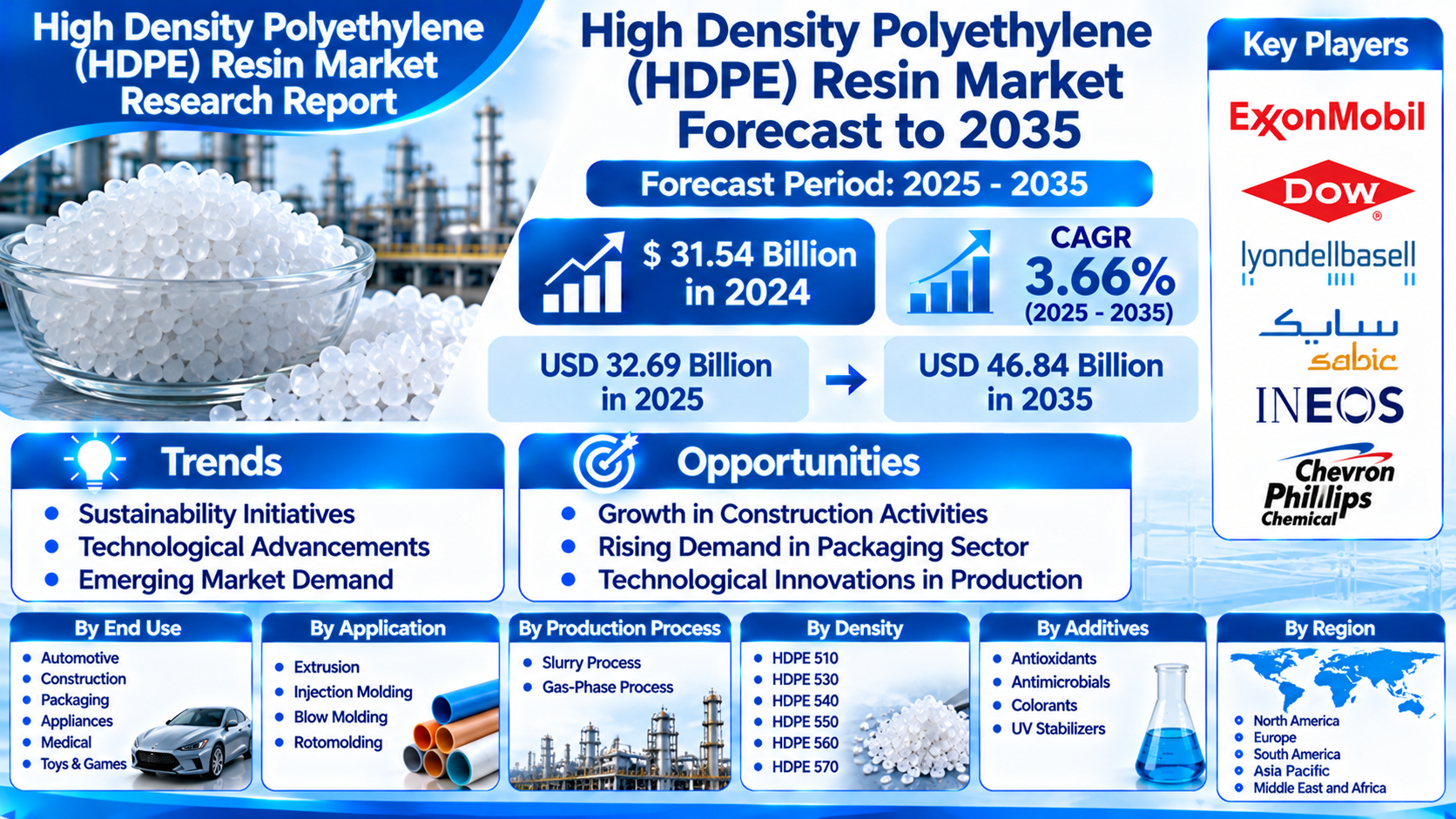
According to Market Research Future® (MRFR), the High Density Polyethylene HDPE Resin Market is expected to reach USD 46.84 billion by 2035, compared with USD 32.69 billion in 2025. The market recorded a valuation of USD 31.54 billion in 2024 and is forecast to grow at a CAGR of 3.66% from 2025 to 2035. Its outlook reflects demand from packaging and construction, alongside applications in automotive, appliances, medical products, and toys and games. Sustainability initiatives, technological advancements, and emerging market demand are also shaping the industry's direction.
Market Structure and Long-Term Prospects
High density polyethylene resin is represented across a diverse set of end-use industries and manufacturing applications. The market covers automotive, construction, packaging, appliances, medical, and toys and games. This range connects HDPE resin demand to several areas of industrial production and consumer goods manufacturing.
The market's valuation is projected to rise from USD 32.69 billion in 2025 to USD 46.84 billion in 2035. The reported CAGR of 3.66% for the forecast period indicates steady expansion. Its 2024 market size of USD 31.54 billion provides a reference for the industry's position before the forecast period begins.
The report identifies sustainability initiatives, technological advancements, and emerging market demand as key trends. It also highlights three opportunities: growth in construction activities, rising demand in the packaging sector, and technological innovations in production. Together, these factors describe the main areas expected to influence the market's development.
Packaging and Construction Demand
Packaging is a central opportunity area for HDPE resin. The report specifically identifies rising demand in the packaging sector, while packaging is also included as a major end-use category. This alignment highlights the importance of packaging customers to the industry's overall demand outlook.
Construction is another significant area of opportunity. Growth in construction activities is identified as a factor that can support market development. The construction sector also appears in the end-use segmentation, connecting the market's opportunity assessment with its broader customer base.
These two sectors provide important demand channels, but they do not represent the full market. Automotive, appliances, medical, and toys and games are also included in the end-use classification. This diversified structure gives the industry exposure to several markets with different product and manufacturing requirements.
End-Use Diversity and Application Categories
The end-use segmentation shows how widely HDPE resin is positioned across commercial and industrial activity. Automotive and appliances represent manufacturing-related markets, while medical and toys and games connect the material with other product categories. The inclusion of packaging and construction further broadens the market's scope.
Applications are classified into Extrusion, Injection Molding, Blow Molding, and Rotomolding. These four categories provide the processing framework used in the report. They represent different routes through which resin is converted into products for downstream industries.
The relationship between end use and application is important to the market's structure. Resin demand is connected both to the industries purchasing the material and to the processes used to manufacture finished products. The supplied information does not provide a revenue breakdown for individual applications, so the relative contribution of each process cannot be determined.
Production Processes and Resin Density
The market's production process segmentation consists of the Slurry Process and Gas-Phase Process. These categories distinguish the manufacturing routes included in the report. They form part of the supply-side structure and provide a basis for assessing production across the HDPE resin industry.
Density classification is divided into HDPE 510, HDPE 530, HDPE 540, HDPE 550, HDPE 560, and HDPE 570. This detailed segmentation identifies six categories within the market's resin portfolio. The range demonstrates that the report assesses multiple density grades rather than treating HDPE resin as a single undifferentiated product.
Both production process and density are relevant to understanding the market's supply structure. The available data does not identify the largest production process or the leading density category. It also does not provide grade-specific forecasts or market shares.
Additives Across the Market
Four additive categories are included in the report: Antioxidants, Antimicrobials, Colorants, and UV Stabilizers. Their presence in the segmentation reflects the role of additives within the HDPE resin market's product structure.
Different end-use sectors may have varying requirements, and the additive categories provide a framework for examining this aspect of the market. Packaging, construction, automotive, appliances, medical, and toys and games represent a broad set of applications with different product expectations.
The supplied information does not provide detailed formulation data or additive-level revenue estimates. It therefore supports an overview of the market's additive segmentation without establishing the relative importance of individual categories.
Sustainability and Emerging Market Demand
Sustainability initiatives are one of the major trends identified in the market research. Environmental considerations are relevant to materials producers and the industries that use their products. This trend places sustainability among the factors companies must consider when evaluating product development and market positioning.
Emerging market demand is another identified trend. This points to the relevance of developing markets within the industry's growth outlook. Demand across packaging, construction, automotive, and other end-use sectors may contribute to the market's opportunities in these areas, although the supplied data does not provide country-level forecasts.
Technological advancements complete the report's list of major trends. The separate opportunity in technological innovations in production reinforces the role of manufacturing development. Producers will need to monitor these changes while addressing the requirements of their downstream customers.
Regional Scope and Competitive Landscape
The global market assessment covers North America, Europe, South America, Asia Pacific, and the Middle East and Africa. These regions provide the geographic structure for the report. The supplied information does not include individual regional market sizes or growth rates, preventing a comparison of regional performance.
The key companies identified are ExxonMobil, Dow, LyondellBasell, SABIC, INEOS, and Chevron Phillips Chemical. These participants form the competitive landscape described in the report. Their presence reflects the involvement of major chemical and materials companies in the HDPE resin sector.
Competition is influenced by production capabilities, resin categories, application requirements, and customer demand. Companies also operate in an environment shaped by sustainability initiatives, technological progress, and emerging market demand. The report details provided do not disclose company-level market shares or rank these participants by revenue.
Outlook Through 2035
The HDPE resin market is projected to grow from USD 32.69 billion in 2025 to USD 46.84 billion in 2035, with a stated CAGR of 3.66%. Its 2024 valuation was USD 31.54 billion. The forecast reflects demand across a wide range of industries and manufacturing applications.
Growth in construction activities and rising demand in the packaging sector are the principal demand-side opportunities. Technological innovations in production offer an additional area for development. Sustainability initiatives and emerging market demand will also influence the industry's direction.
With applications spanning extrusion, injection molding, blow molding, and rotomolding, and product classifications covering several density grades and additives, the market has a broad operating structure. Its development through 2035 will depend on how suppliers respond to changing end-use requirements, production innovation, and market demand.

