

Global R-PET Flakes and Pellets Market Outlook 2025–2035: Trends and Opportunities

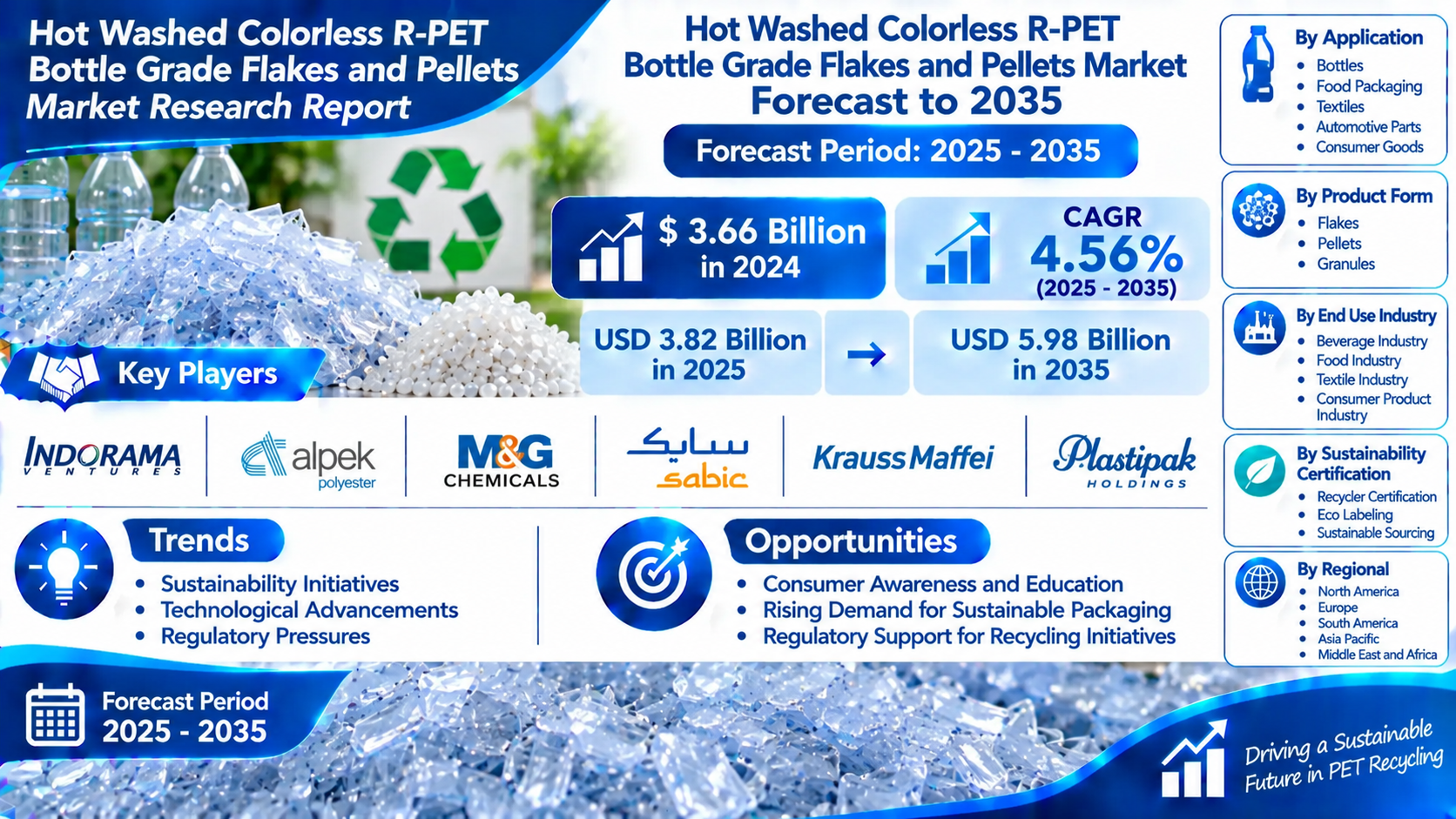
According to Market Research Future® (MRFR), the Hot Washed Colorless R-PET Bottle Grade Flakes and Pellets Market is projected to grow from USD 3.82 billion in 2025 to USD 5.98 billion by 2035, registering a compound annual growth rate (CAGR) of 4.56% during the forecast period from 2025 to 2035. The market was valued at USD 3.66 billion in 2024. Its development is shaped by sustainability initiatives, technological advancements, and regulatory pressures. Rising demand for sustainable packaging, consumer awareness, and regulatory support for recycling initiatives are among the opportunities influencing the industry's outlook.
Market Overview and Growth Outlook
The market for hot washed colorless recycled polyethylene terephthalate (R-PET) bottle grade flakes and pellets is connected to the wider development of recycling and sustainable material supply chains. Its segmentation covers applications, product forms, end-use industries, sustainability certifications, and geographic regions. This structure reflects the different ways recycled PET materials enter manufacturing and packaging value chains.
The market is expected to increase from USD 3.82 billion in 2025 to USD 5.98 billion in 2035. The stated CAGR of 4.56% indicates continued expansion over the forecast period. The 2024 market valuation of USD 3.66 billion provides a reference point for the industry's position before the forecast period.
Three trends are highlighted in the report: sustainability initiatives, technological advancements, and regulatory pressures. These themes reflect the growing importance of environmental considerations, improvements in recycling and processing, and policy developments affecting the use of recycled materials. The opportunity landscape also includes consumer awareness and education, rising demand for sustainable packaging, and regulatory support for recycling initiatives.
Sustainability and the Role of Recycled PET
Sustainability is a central theme in the R-PET market. The report identifies sustainability initiatives as a major trend and sustainable packaging demand as an important opportunity. This reflects the relevance of recycled materials to businesses and industries seeking to incorporate environmental considerations into packaging and product decisions.
Consumer awareness and education are also identified as opportunities. Awareness can influence purchasing preferences and encourage interest in products and packaging associated with recycling. As consumers become more informed about sustainability issues, manufacturers and brands may face stronger expectations to consider recycled material options.
The report does not quantify the effect of consumer awareness on market revenue, but its inclusion as an opportunity demonstrates its relevance to the industry's future. Education, communication, and greater understanding of recycling initiatives can form part of the wider environment supporting recycled PET demand.
Applications Across Packaging and Other Industries
The market's application segmentation includes Bottles, Food Packaging, Textiles, Automotive Parts, and Consumer Goods. Bottles and food packaging are particularly relevant to the market's bottle-grade focus, while textiles, automotive parts, and consumer goods extend its scope into other manufacturing areas.
The range of applications demonstrates that recycled PET materials can serve several parts of the economy. Demand is not confined to one packaging format or one industry. The report's inclusion of automotive parts and textiles alongside bottles and food packaging reflects a wider application landscape for the material.
Food packaging is another important category within this structure. The opportunity associated with rising demand for sustainable packaging supports the relevance of packaging-related applications. However, the supplied market information does not provide individual application shares or specify which category contributes the most revenue.
Product Forms: Flakes, Pellets, and Granules
The report divides the market by product form into Flakes, Pellets, and Granules. These three categories represent the formats covered in the market assessment. Their inclusion highlights the different forms in which recycled PET material is supplied to downstream users.
Product form is an important part of the market's structure because buyers and manufacturers operate with different material requirements. Flakes, pellets, and granules provide the classification framework used in the report to assess product offerings.
The available information does not provide separate market sizes or growth rates for these forms. It therefore does not establish which format leads the market or is expected to expand most quickly. Nevertheless, the segmentation indicates that the industry serves a varied range of processing and manufacturing requirements.
End-Use Industries and Demand Channels
The end-use industry segmentation covers the Beverage Industry, Food Industry, Textile Industry, and Consumer Product Industry. These categories provide a view of the sectors purchasing or using the market's products.
The beverage industry is directly relevant to bottle-grade recycled PET, while the food industry connects with the report's food packaging application. The textile industry and consumer product industry broaden the market's reach beyond packaging. This diversified end-use structure gives the industry several demand channels.
The relationship between applications and end-use industries is important. Bottles and food packaging describe application areas, while beverage and food industries identify customer sectors. Textiles and consumer products further demonstrate the range of manufacturing activities represented in the market. The supplied data does not include separate valuations for these end-use categories.
Sustainability Certification and Market Confidence
Sustainability certification is another dimension of the report's segmentation. The categories include Recycler Certification, Eco Labeling, and Sustainable Sourcing. Their presence indicates that certification and sourcing considerations form part of the market's structure.
These categories are relevant to the wider sustainability theme. Buyers and businesses may consider certification, labeling, and sourcing practices when evaluating recycled materials and their supply chains. The report's inclusion of these factors reflects the importance of transparency and sustainability-related requirements in the market.
Regulatory pressures are also identified as a major trend, while regulatory support for recycling initiatives is listed as an opportunity. These developments can influence how recycled materials are assessed and incorporated into products. The supplied information does not identify specific regulations or certification schemes, so the categories should be understood as the report's broad market classifications.
Technological Advancements and Regulatory Pressures
Technological advancements are a key trend shaping the R-PET market. Developments in recycling and processing can influence the ability of manufacturers to supply recycled material in forms that meet downstream requirements. The report identifies technology as an important influence but does not specify particular processes or quantify their impact.
Regulatory pressures form another major trend. Policy and compliance considerations can affect the operating environment for recycling initiatives and companies using recycled materials. The opportunity associated with regulatory support suggests that supportive frameworks may help encourage recycling activity and sustainable packaging adoption.
These factors are closely related to the market's sustainability focus. Technological progress concerns the capabilities of recycling and processing systems, while regulation shapes the environment in which those systems operate. Both will remain relevant as the market develops.
Regional Market Coverage
The report examines the market across North America, Europe, South America, Asia Pacific, and the Middle East and Africa. This regional segmentation provides a global framework for assessing demand and industry activity.
Regional market conditions may differ according to recycling infrastructure, packaging demand, regulatory frameworks, and industrial requirements. However, the supplied information does not provide regional market sizes, country-level estimates, or comparative growth rates. It is therefore not possible to identify a leading or fastest-growing region based on the available figures.
Competitive Landscape
The key players identified in the report are Indorama Ventures, Alpek Polyester, M&G Chemicals, SABIC, KraussMaffei Group, and Plastipak Holdings. These companies form part of the competitive landscape covered by the research.
Competition takes place across product forms, applications, end-use industries, and sustainability-related requirements. Market participants must consider technological developments, regulatory pressures, and customer expectations around recycled materials. The supplied information identifies the key companies but does not provide individual market shares or comparative financial performance.
Outlook Through 2035
The hot washed colorless R-PET bottle grade flakes and pellets market is projected to reach USD 5.98 billion by 2035, compared with USD 3.82 billion in 2025. The stated CAGR is 4.56% for 2025–2035. Sustainability initiatives, technological advancements, and regulatory pressures are central trends shaping this outlook.
Consumer awareness and education, rising demand for sustainable packaging, and regulatory support for recycling initiatives are the main opportunities identified. The market's applications across bottles, food packaging, textiles, automotive parts, and consumer goods, together with its different product forms and end-use industries, provide a broad foundation for future development.

