

Steel Pipes Tube Market Insights: Demand Across Construction, Oil and Gas, and Automotive

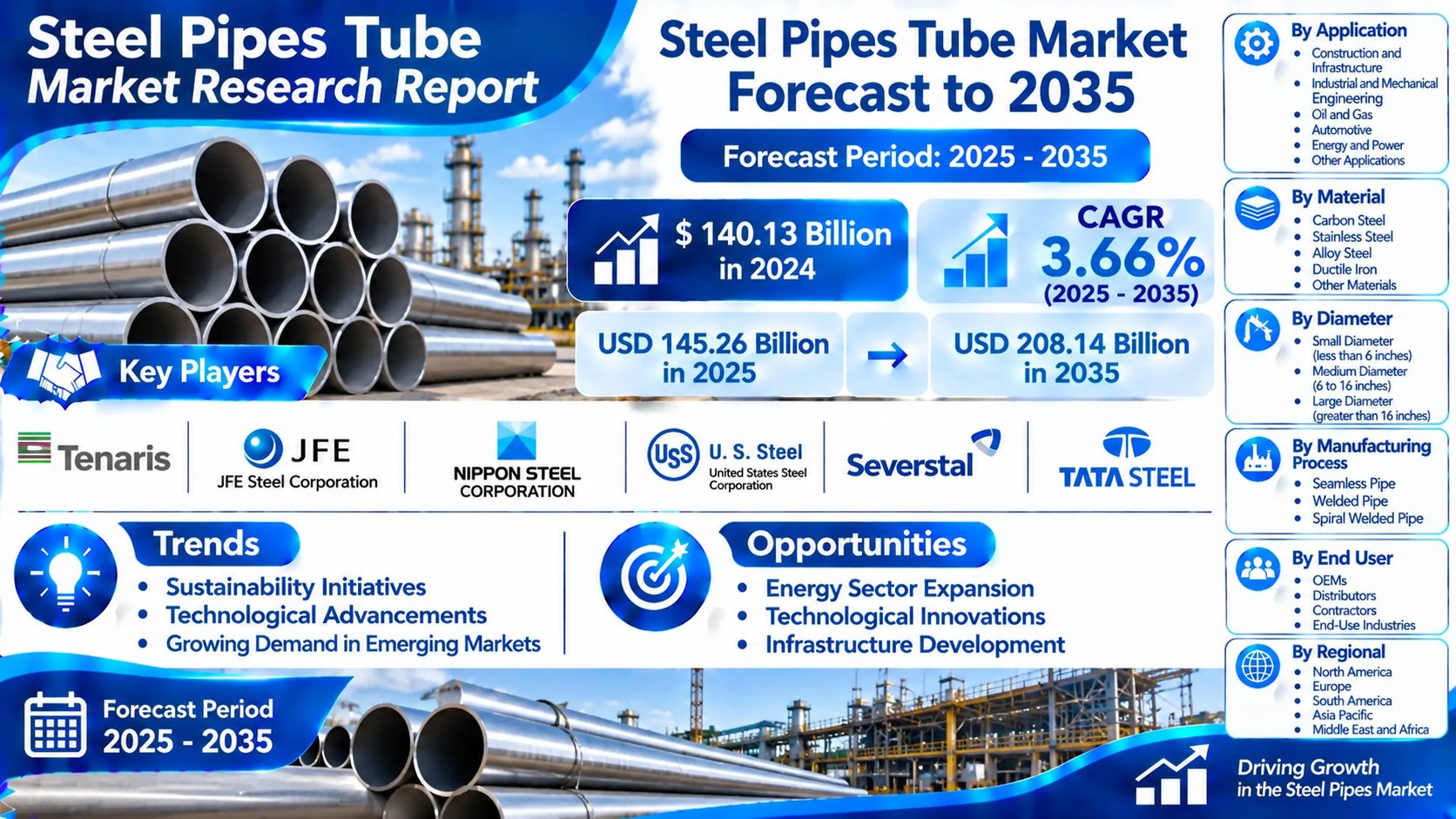
According to Market Research Future® (MRFR), the Steel Pipes Tube Market is forecast to reach USD 208.14 billion by 2035, compared with USD 145.26 billion in 2025, advancing at a CAGR of 3.66% over the 2025–2035 forecast period. The market recorded a valuation of USD 140.13 billion in 2024. Its development is tied to requirements across infrastructure, industrial engineering, oil and gas, automotive, and energy and power, with opportunities arising from energy sector expansion, technological innovations, and infrastructure development.
Market Valuation and Industry Scope
Steel pipes and tubes are used across a wide range of industrial and infrastructure applications. The market's segmentation reflects this breadth through classifications based on application, material, diameter, manufacturing process, and end user. These dimensions help define the product categories and commercial channels included in the industry.
The market is projected to expand from USD 145.26 billion in 2025 to USD 208.14 billion in 2035. Its stated CAGR of 3.66% describes the expected growth rate over the ten-year forecast period. The 2024 market size of USD 140.13 billion provides a historical point of comparison. The figures indicate continued market expansion, although the rate of development may differ across applications and product categories.
Application Diversity and Industrial Requirements
Construction and infrastructure is one of the principal applications covered in the report. Steel pipes and tubes form part of the product landscape serving infrastructure and construction requirements. This application is closely connected to the opportunity identified around infrastructure development, which may support demand as projects and investment activity expand.
Industrial and mechanical engineering is another application category. The market also includes oil and gas, automotive, energy and power, and other applications. The presence of oil and gas and energy and power as separate categories highlights the market's coverage of multiple energy-related activities. Automotive and industrial engineering further broaden the range of industries represented.
The application structure creates exposure to different demand conditions. Infrastructure investment, industrial activity, energy projects, and automotive production each contribute to the market's overall environment. The supplied data does not provide application-level market shares, so the contribution of individual sectors cannot be ranked.
Material Selection and Diameter Segmentation
The material categories include carbon steel, stainless steel, alloy steel, ductile iron, and other materials. This classification reflects the different product materials represented in the market. Material selection can be relevant to the requirements of individual applications and the specifications of projects across construction, engineering, and energy.
The report also distinguishes products by diameter. Small diameter pipes are defined as less than 6 inches, medium diameter pipes measure 6 to 16 inches, and large diameter pipes are greater than 16 inches. This segmentation provides a dimensional view of the market and covers products suited to different project requirements.
The three diameter categories span a broad range of sizes. Their inclusion allows the market to be assessed across small, medium, and large products rather than treating all steel pipes and tubes as one uniform category. No diameter-specific revenue figures or market rankings have been supplied.
Manufacturing Processes and Market Supply
Manufacturing process is another defining market dimension. The report identifies seamless pipe, welded pipe, and spiral welded pipe. These categories represent the production methods included in the market assessment and provide a basis for distinguishing products according to their manufacturing route.
Technological Advancements are identified as a key trend, while Technological Innovations are listed as an opportunity. These themes are relevant to a market in which manufacturing processes form a core segmentation category. Technological development can influence the industry's ability to respond to product specifications and changing customer requirements. The supplied information does not identify particular process innovations or quantify their impact.
End users include OEMs, distributors, contractors, and end-use industries. These categories show that market participants operate at different points in the supply and procurement chain. Distributors and contractors are included alongside OEMs, while end-use industries represent a wider customer base. This structure illustrates the multiple channels through which steel pipes and tubes reach industrial and infrastructure projects.
Sustainability and Emerging Market Demand
Sustainability Initiatives are included among the market's key trends. The focus on sustainability places production and resource considerations within the broader industry outlook. As an industrial materials market, steel pipes and tubes are connected to manufacturing activities across several sectors, making sustainability an important consideration in the market's development.
Growing Demand in Emerging Markets is another identified trend. Emerging economies can provide opportunities as industrial and infrastructure requirements evolve. This trend is closely related to the report's infrastructure development opportunity and the broad application base of steel pipes and tubes.
The market's regional scope includes North America, Europe, South America, Asia Pacific, and the Middle East and Africa. This coverage demonstrates the geographic breadth of the report. However, no regional market values or growth rankings are included in the supplied information, preventing a comparison of regional performance.
Energy and Infrastructure Opportunities
Energy Sector Expansion is identified as an opportunity for market participants. The report's application categories include both oil and gas and energy and power, making energy development directly relevant to the market's structure. Expansion across these sectors may support demand for steel pipe and tube products in related projects.
Infrastructure Development is another major opportunity. Construction and infrastructure is specifically identified as an application category, while contractors and end-use industries are included among the market's customer groups. This combination connects project development with the supply and distribution of steel pipes and tubes.
Technological Innovations provide an additional opportunity. Developments in manufacturing and product capabilities may help suppliers address evolving requirements across different applications and diameter ranges. The potential impact will depend on adoption and the needs of individual customer sectors.
Competitive Landscape
The key players identified in the report are Tenaris, JFE Steel Corporation, Nippon Steel Corporation, United States Steel Corporation, Severstal, and Tata Steel. These companies form part of the competitive landscape in the steel pipes and tubes industry.
Market competition spans several dimensions, including material categories, product diameters, manufacturing processes, and end-user relationships. Sustainability initiatives and technological advancements are also identified as trends influencing the sector. These factors contribute to an industry environment in which manufacturers and suppliers serve varied infrastructure and industrial requirements.
Long-Term Market Outlook
The Steel Pipes Tube Market is projected to reach USD 208.14 billion by 2035, rising from USD 145.26 billion in 2025 at a CAGR of 3.66%. Its broad application coverage and range of materials, diameters, manufacturing processes, and end users define a diversified industry structure. Energy sector expansion and infrastructure development are key opportunities, while technological innovation, sustainability initiatives, and emerging market demand shape the wider outlook through 2035.

