

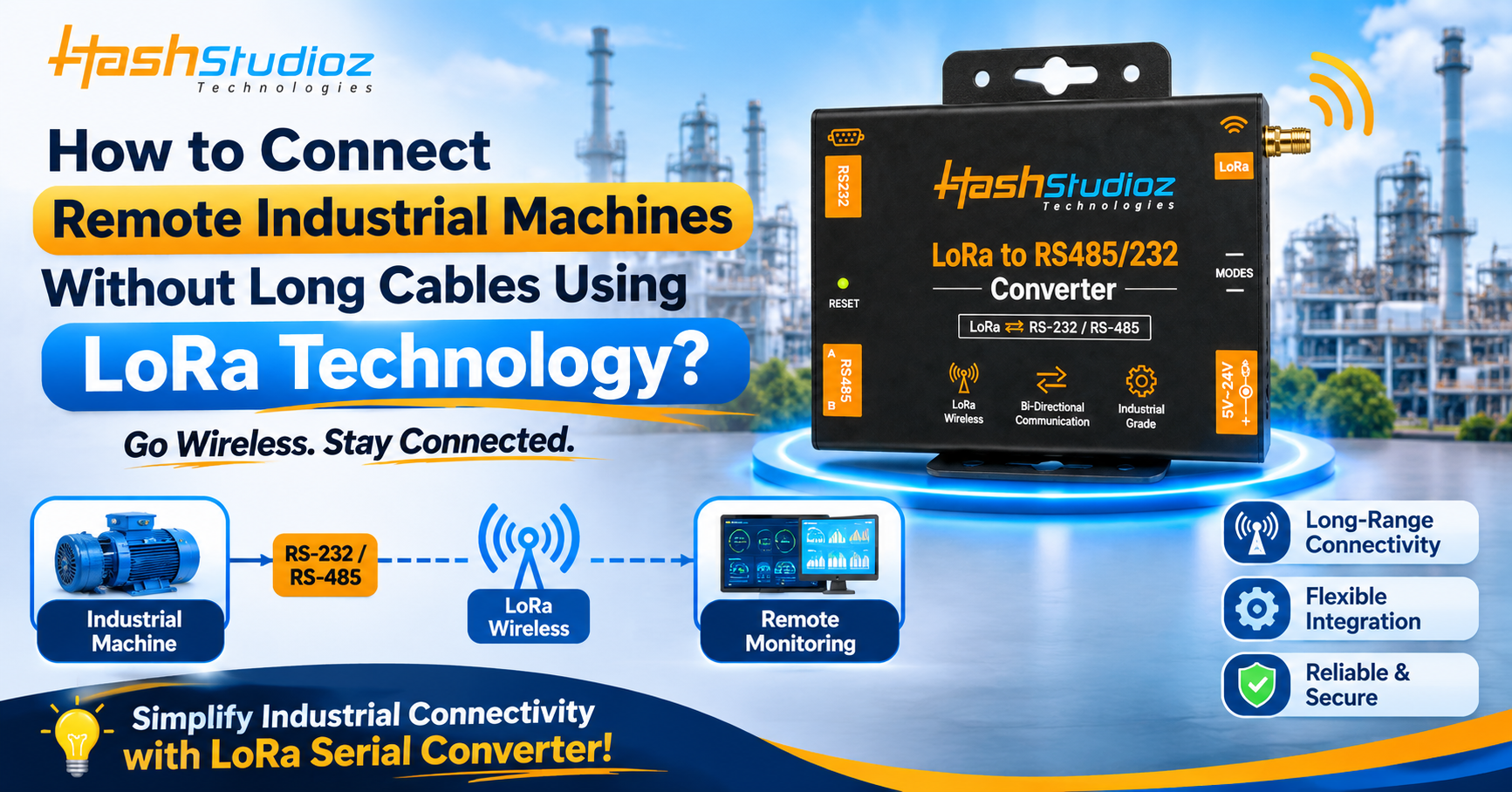
How to Connect Remote Industrial Machines Without Long Cables Using LoRa Technology

Imagine running an industrial facility where machines, sensors, and controllers are installed across different buildings or large outdoor areas. Some equipment may be located hundreds of meters away from the central control room. You need to collect machine data, monitor performance, and exchange information between devices. But there is one major challenge: installing long communication cables is expensive, time-consuming, and sometimes impossible.
So, how can you connect remote industrial machines without extending traditional RS-232 or RS-485 cables across your facility? LoRa technology offers a practical wireless communication solution. It enables long-range data transmission with low power consumption, making it useful for industrial environments where wired connectivity is difficult.
By using a LoRa to RS-232 RS-485 Converter, businesses can connect existing serial-based industrial equipment through wireless communication instead of depending on long physical cables.
A LoRa Serial Converter bridges traditional serial interfaces and wireless LoRa communication. It helps industries modernize existing equipment without completely replacing their current infrastructure.
Why Is Connecting Remote Industrial Machines So Difficult?
Industrial facilities often contain machines installed at different locations. Connecting all these devices to a central monitoring system can create several technical and financial challenges.
Let's understand the most common problems.
1. High Costs of Installing Long Communication Cables
Traditional RS-232 and RS-485 communication requires physical connections between devices.
When machines are located far apart, businesses may need long cables, cable trays, conduits, connectors, and additional installation work.
This increases project costs and makes future equipment relocation more complicated.
2. Difficult Installation in Remote Locations
Some industrial machines operate in outdoor environments, agricultural fields, water treatment facilities, warehouses, and remote utility stations.
Installing communication cables in these locations can be difficult because of distance, physical obstacles, and environmental conditions.
3. Limited Flexibility
Wired communication systems can become difficult to expand when businesses add new machines or relocate existing equipment.
Every new connection may require additional wiring and installation work.
4. Communication Challenges Across Large Areas
Industrial facilities may contain multiple buildings, production zones, and remote monitoring points.
Maintaining reliable communication between these locations can require additional networking infrastructure.
5. Maintenance and Cable Damage
Long cables installed in industrial environments may experience physical damage, loose connections, or maintenance issues.
Identifying and repairing faults across extensive cable installations can consume valuable time.
These challenges make wireless industrial communication an attractive alternative.
What Is LoRa Technology and How Does It Work?
LoRa stands for Long Range. It is a wireless communication technology designed for long-distance data transmission with relatively low power consumption.
Unlike conventional Wi-Fi, which is commonly used for higher-bandwidth local networking, LoRa is suitable for applications that transmit smaller amounts of information over longer distances.
It is particularly useful for industrial monitoring, sensor communication, remote equipment connectivity, and IoT applications.
How Does LoRa Wireless Communication Work?
LoRa technology uses radio-frequency communication to transmit information between compatible wireless devices.
A typical industrial setup works as follows:
-
An industrial machine generates operational data.
-
The machine sends information through an RS-232 or RS-485 serial interface.
-
A compatible LoRa converter receives the serial information.
-
The converter transmits the data wirelessly using LoRa.
-
A paired LoRa converter at the receiving end receives the wireless transmission.
-
The receiving converter delivers the information to another serial device or monitoring system.
This approach eliminates the need for a long physical serial cable between the two communication points.
Why Is LoRa Useful for Industrial Applications?
LoRa offers several advantages for industrial environments:
-
Long-range wireless communication.
-
Low power consumption.
-
Reduced dependence on physical communication cables.
-
Support for remote equipment connectivity.
-
Flexible deployment across industrial locations.
-
Suitability for small-data monitoring applications.
However, actual communication distance depends on antenna placement, obstacles, interference, frequency regulations, and environmental conditions.
How to Connect Remote Industrial Machines Without Long Cables Using a LoRa Converter
A LoRa to RS-232 RS-485 Converter provides a simple way to establish wireless communication between existing serial devices.
Let's understand the complete process.
Step 1: Identify Your Machine's Communication Interface
Before selecting a converter, identify the communication interface used by your industrial equipment.
Common serial interfaces include:
RS-232: Commonly used in controllers, instruments, and industrial equipment requiring serial communication.
RS-485: Widely used in industrial automation, PLCs, energy meters, sensors, and Modbus RTU devices.
Check your machine's documentation to identify its interface, baud rate, data bits, parity, and stop bits.
Step 2: Install the LoRa Serial Converter
Connect the machine's RS-232 or RS-485 interface to the corresponding serial port on the LoRa converter.
The converter acts as a communication bridge between the machine and the wireless network.
The IoTStudioz Industrial RS232/RS485 to LoRa Wireless Converter supports:
-
One RS-232 DB9 interface.
-
One RS-485 terminal interface.
-
5V–24V DC power input.
-
Configurable UART parameters.
-
Software-adjustable RF transmission power.
These features allow integration with different serial-based industrial devices.
Step 3: Configure Wireless Communication Parameters
After connecting the hardware, configure the converter using its configuration software.
Important settings include:
-
Device address.
-
RF frequency.
-
Transmission power.
-
Baud rate.
-
Data rate.
-
UART parameters.
-
Transmission mode.
-
Network settings.
Both communication endpoints must have compatible wireless and serial configurations.
Correct configuration helps establish reliable communication between remote machines.
Step 4: Establish Wireless Communication Between Devices
Install another compatible LoRa converter at the receiving location.
The first converter collects serial information from the industrial machine and transmits it wirelessly.
The receiving converter then delivers the received information through its RS-232 or RS-485 interface.
Depending on the application, communication can use different transmission modes:
Transparent Transmission: Transfers serial information wirelessly without requiring application-level changes to the data content.
Fixed-Point Transmission: Sends information to a specific configured device address.
Broadcast Transmission: Sends information to multiple compatible receiving devices.
The supported transmission modes make it possible to design different industrial communication arrangements.
Step 5: Monitor and Exchange Machine Data
Once wireless communication is established, the receiving system can process the collected information.
For example, industrial operators can use the connection to:
-
Read machine operating parameters.
-
Monitor sensor readings.
-
Collect energy meter information.
-
Exchange controller data.
-
Monitor remote equipment conditions.
-
Integrate serial devices into existing monitoring applications.
The result is a wireless communication link between remote industrial equipment without installing a long RS-232 or RS-485 cable.
Practical Example: Connecting Two Remote Machines Without Long Cables
Imagine a manufacturing company operating two production areas separated by a large distance.
One area contains a PLC, while the other contains an industrial monitoring system.
Both devices use RS-485 communication.
Traditionally, the company would need to install a long RS-485 cable between the two locations.
This could involve additional wiring, cable protection, installation costs, and maintenance.
Instead, the company can use two compatible LoRa converters.
How the Setup Works
Location A – Machine Side
-
Connect the PLC to the first LoRa converter using RS-485.
-
Configure the required serial parameters.
-
Set the wireless communication parameters.
Location B – Monitoring Side
-
Connect the second LoRa converter to the monitoring controller.
-
Configure compatible communication settings.
-
Install suitable antennas at both locations.
Wireless Communication
-
The first converter receives serial information from the PLC.
-
LoRa transmits the information wirelessly.
-
The second converter receives the data.
-
The monitoring controller processes the received information.
For a reliable installation, the system must be tested for signal strength, data integrity, interference, and application-specific communication requirements.
Key Features of a LoRa to RS-232 RS-485 Converter
Choosing the right converter is important for building a reliable industrial wireless communication system.
The IoTStudioz Industrial RS232/RS485 ↔ LoRa Wireless Converter includes several features designed for industrial applications.
1. Dual Serial Interface Support
The converter provides RS-232 and RS-485 interfaces, making it suitable for connecting different types of industrial serial equipment.
2. Long-Range Wireless Communication
The product specifies a transmission distance of up to 5–10 km under line-of-sight conditions, depending on antenna and environment.
This makes it suitable for evaluating wireless connectivity across large industrial areas.
3. Adjustable RF Transmission Power
The device supports software-configurable RF output power up to 20 dBm.
Users can configure transmission power according to their communication requirements and applicable regional regulations.
4. Multiple Transmission Modes
Transparent, fixed-point, and broadcast transmission modes provide flexibility for different communication architectures.
5. Flexible Data Configuration
The converter supports configurable UART baud rates and wireless data rates from 0.3 kbps to 19.2 kbps.
This helps users match communication settings with their connected equipment.
6. Industrial Power Supply
The device supports a 5V–24V DC power input, allowing integration into different industrial power environments.
Where Can LoRa Serial Converters Be Used?
LoRa-based serial communication is useful in applications where industrial devices are distributed across large areas.
Here are some practical examples.
1. Industrial Automation
Factories often operate PLCs, HMIs, CNC machines, and controllers in different production areas.
A LoRa Serial Converter can help establish wireless serial communication between compatible devices.
2. Smart Agriculture and Irrigation
Agricultural installations may have irrigation controllers, soil monitoring equipment, water pumps, and weather stations spread across large fields.
LoRa connectivity can help exchange monitoring information without installing extensive communication cables.
3. Water and Wastewater Management
Water treatment facilities use pumps, flow meters, pressure sensors, and tank monitoring equipment.
Wireless serial connectivity can help transfer information from remote monitoring points.
4. Energy Monitoring
Energy meters and power monitoring devices may be installed across multiple buildings or distribution points.
A compatible converter can help establish wireless communication with existing serial-based monitoring equipment.
5. Building Management Systems
Large commercial buildings use HVAC controllers, lighting systems, and monitoring equipment.
Wireless serial communication can simplify connections where physical wiring is difficult.
6. Smart City Infrastructure
Street lighting, environmental monitoring, parking systems, and utility infrastructure often operate across distributed locations.
LoRa-based connectivity can help connect compatible serial devices for remote monitoring applications.
What Should You Consider Before Choosing a LoRa Serial Converter?
Before purchasing a LoRa converter, evaluate these important factors.
1. Serial Interface Compatibility
Check whether your industrial equipment uses RS-232, RS-485, or another communication interface.
2. Communication Distance
Estimate the actual distance between devices and consider physical obstacles, antenna height, and environmental conditions.
Do not assume that the advertised maximum line-of-sight range will be achieved in every installation.
3. Frequency Compatibility
Verify that the converter's supported frequency band is permitted for your deployment location.
The selected product supports 868 MHz and 915 MHz configurations. Check the applicable regional frequency and transmission regulations before installation.
4. Data Transmission Requirements
Check the amount of information your machines need to exchange.
LoRa is generally appropriate for relatively small data payloads rather than high-bandwidth applications such as video streaming.
5. Power Supply Requirements
Confirm that the converter's power input matches the available industrial power source.
6. Configuration and Transmission Modes
Choose a device that provides the configuration options and transmission modes required by your communication architecture.
Conclusion
Connecting remote industrial machines does not always require installing long communication cables. With LoRa technology, businesses can establish wireless communication between compatible RS-232 and RS-485 devices, making industrial connectivity more flexible and easier to deploy across distributed locations.
A LoRa to RS-232 RS-485 Converter helps bridge traditional serial equipment and wireless communication, allowing businesses to exchange machine data without depending on extensive physical wiring.
Whether you are connecting remote PLCs, monitoring energy meters, managing agricultural equipment, or building an industrial IoT network, a LoRa Serial Converter can provide a practical wireless connectivity option.
The key is to select the right converter, configure both communication endpoints correctly, and evaluate the wireless environment before deployment.

