

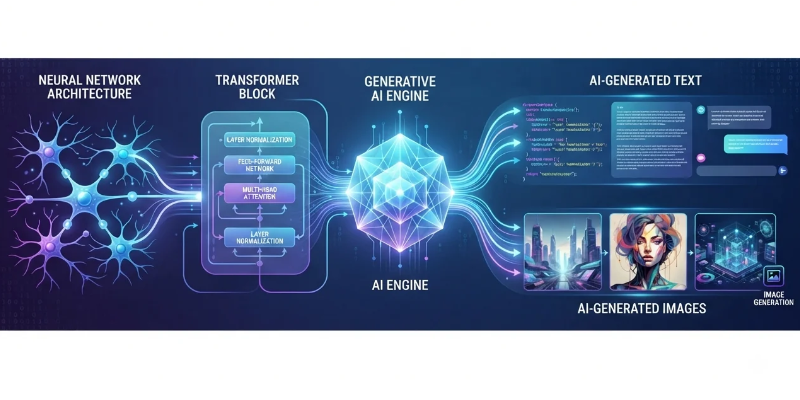

Generative Artificial Intelligence (AI) is changing how people create text, images, videos, music, and other forms of digital content. Behind these capabilities are neural network architectures that help machines learn patterns, understand information, and generate new outputs. These frameworks serve as the basis for contemporary Generative AI applications, such as chatbots, image creation tools, and smart virtual assistants.
Understanding how neural network architectures work can help you explore the technology behind these innovations. From basic artificial neural networks to advanced transformer models, each architecture plays a different role in developing intelligent systems. If you want to build a strong foundation in this growing field, consider enrolling in Gen AI Courses in Coimbatore at FITA Academy to explore essential concepts and practical applications of Generative AI.
What Are Neural Network Architectures?
Neural network architectures describe how artificial neurons are arranged and connected within an AI model. These networks draw inspiration from how the human brain interprets information. They contain layers of connected nodes that receive data, identify patterns, and produce results.
A standard neural network comprises an input layer, several hidden layers, and an output layer. The input layer receives information, while hidden layers process it using learned weights and mathematical operations. Finally, the output layer generates a prediction or response. The architecture determines how information moves through the network and how effectively it learns complex patterns.
Types of Neural Network Architectures Used in Generative AI
Different neural network architectures support different Generative AI tasks. Some are designed to process images, while others specialize in language, audio, or sequential information.
Feedforward Neural Networks
Feedforward neural networks are among the simplest neural network architectures. Data travels in a single direction, flowing from the input layer to the output layer. These networks are useful for basic pattern recognition and prediction tasks. They also provide a foundation for understanding more advanced deep learning models.
Convolutional Neural Networks
Convolutional Neural Networks (CNNs) are mainly designed to process visual information. They identify important image features, such as edges, shapes, textures, and objects. CNNs have contributed to image recognition, image processing, and several image-generation technologies. Their ability to understand visual patterns makes them valuable in computer vision applications.
Recurrent Neural Networks
Recurrent Neural Networks (RNNs) are designed to process sequential information. They use information from previous steps to understand the current input. This makes them useful for language processing, speech recognition, and time-based data. However, traditional RNNs can struggle to remember information across long sequences.
How Transformer Architecture Powers Modern Generative AI
Transformer architecture has become one of the most important developments in modern Generative AI. Unlike traditional sequential models, transformers can process different parts of an input sequence efficiently using an attention mechanism.
The attention mechanism helps a model identify relationships between words and understand which parts of the input are important. This ability allows large language models to understand context and generate meaningful responses.
Transformers are widely used in chatbots, language translation, text summarization, and content generation. They also support multimodal AI systems that work with different types of information, including text and images. If you want to understand these technologies and develop practical AI skills, explore an Artificial Intelligence Course in Coimbatore and take the next step toward learning modern AI concepts.
The Role of Neural Networks in Generative AI Training
Neural networks learn by processing large amounts of training data. During training, the model identifies patterns and adjusts its internal parameters to improve its output. This process involves techniques such as backpropagation and optimization.
The quality of training data and the architecture of the model both influence its performance. A well-designed neural network can learn complex relationships and generate more relevant results. Fine-tuning can further improve a pretrained model for specific tasks and applications. Understanding these training methods is important for anyone interested in developing Generative AI solutions. A structured Artificial Intelligence Course Syllabus can help you explore neural networks, machine learning, deep learning, and other essential concepts in a progressive learning journey.
Why Neural Network Architectures Matter in Modern AI
Neural network architectures influence the accuracy, speed, scalability, and capabilities of Generative AI systems. Choosing the right architecture helps developers build models that suit specific requirements.
For example, CNNs are useful for visual tasks, while transformers are highly effective for language generation and multimodal applications. Advanced architectures also help AI systems understand complex information and create more realistic outputs.
As Generative AI continues to develop, improvements in neural network design will support more powerful and efficient applications across industries.
Neural network architectures are the foundation of modern Generative AI. From basic feedforward networks to CNNs, RNNs, and transformers, each architecture contributes different capabilities to intelligent systems. Understanding these structures provides valuable knowledge about how AI models learn, process information, and generate content. With the progress of technology, advancements in neural networks will keep influencing the future of artificial intelligence.

